

Yellow Asks to Be Seen
One of nine colors of Seeing. Yellow – Attention, Illumination, and the Practice of Noticing
Yellow in the world
Yellow has always occupied a special place in human experience because it is inseparable from light. Long before it became a subject of scientific study, yellow was already embedded in the rhythms of daily life through sunlight, flowering plants, ripening crops, and changing seasons. It is therefore hardly surprising that many cultures have associated yellow with vitality, knowledge, abundance, and celebration. Although these interpretations vary, they share a common foundation: yellow has repeatedly been linked to the idea of illumination, both in a physical and a symbolic sense.
Contemporary research adds another layer to this understanding. Studies in colour psychology suggest that yellow is among the colours most readily detected by the human eye, which helps explain its widespread use in signs, transportation systems, safety markings, and other environments where visibility matters. Designers understand that yellow attracts attention more quickly than many other colours, but research also suggests that attention itself is more complex than simple visual stimulation. Human beings do not merely react to colour. They interpret it through memory, experience, culture, and context.
Perhaps this is why yellow remains so difficult to define. It is simultaneously energetic and reflective, immediate and contemplative. It illuminates the world around us while also encouraging us to think about the nature of perception itself..
A visual constellation of light
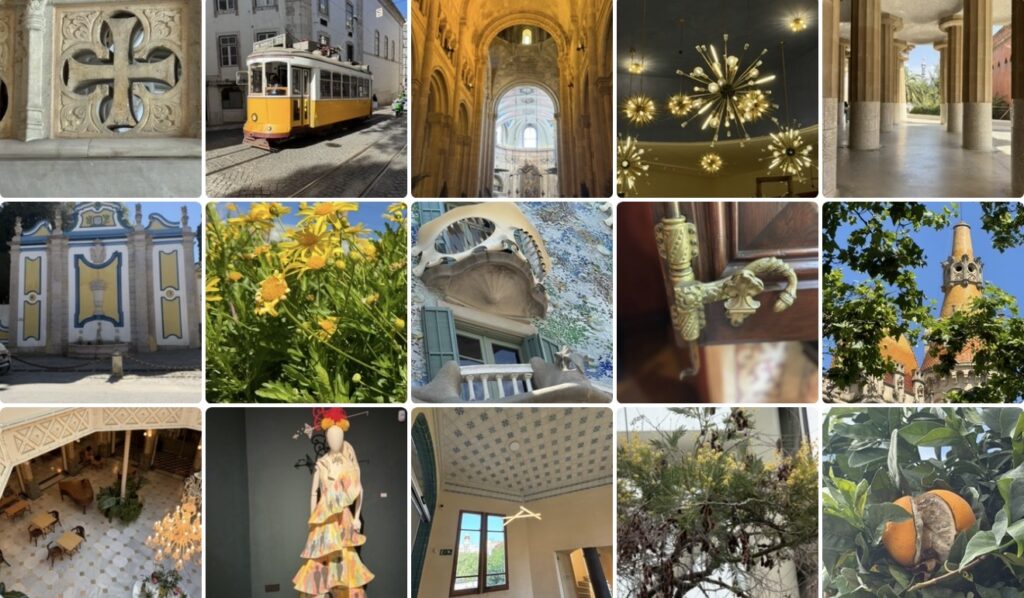
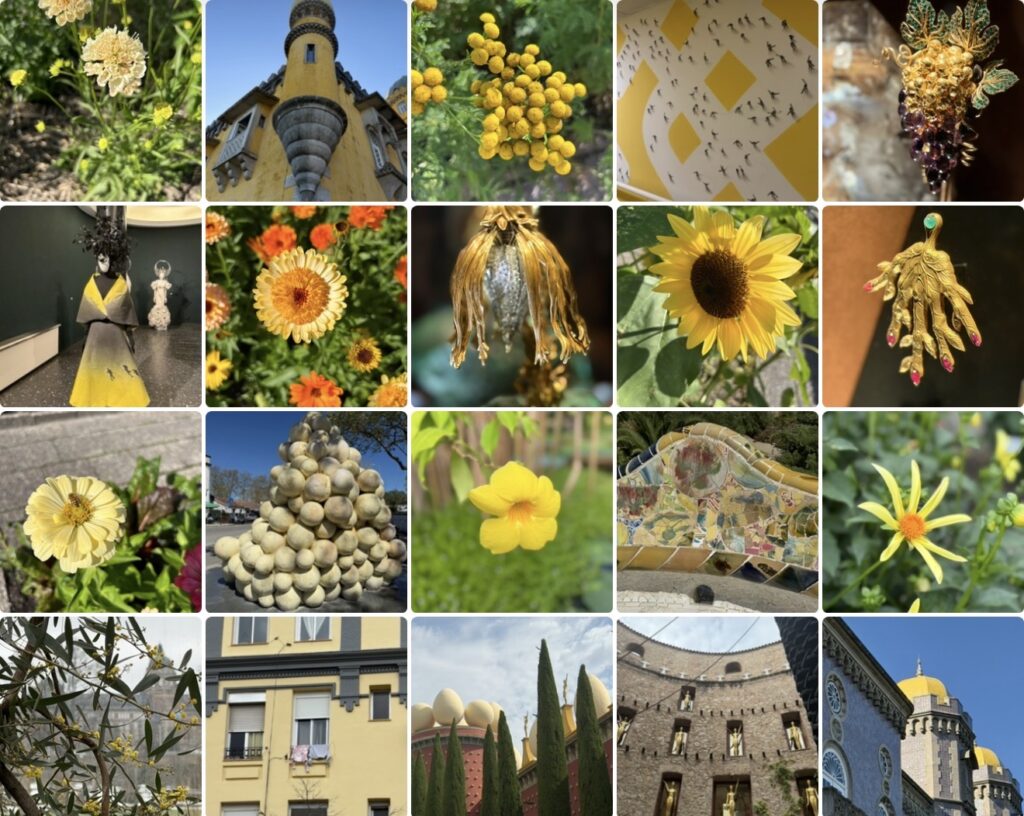
The photographic collection suggests that yellow is less concerned with objects than with relationships. Although flowers naturally dominate many of the images, they do not function as isolated subjects. Instead, they become part of a broader visual dialogue that includes architecture, cultivated landscapes, patterns, textures, and surfaces transformed by light.
What becomes increasingly apparent when the photographs are viewed together is that they all explore different expressions of visibility. Some images reveal strong contrasts between light and shadow, while others depend on subtler transitions. Certain photographs immediately attract attention, whereas others reward a slower and more deliberate form of observation. The collection therefore creates a movement between recognition and discovery, encouraging the viewer to spend time moving back and forth between the individual images.
Another characteristic that emerges from the collage is the relationship between yellow and transformation. Flowers appear at different stages of development, while landscapes suggest seasonal change. Architectural elements interact with light in ways that continuously alter their appearance. Nothing seems entirely fixed. Instead, the photographs capture moments in which light temporarily reveals something that might otherwise have remained unnoticed.
Perhaps this is why the collection feels less like a catalogue of yellow objects and more like an exploration of how attention itself operates.
The art of noticing
The relationship between light and attention has become particularly interesting in a world increasingly defined by information. Contemporary life constantly competes for our attention, often encouraging rapid reactions and fragmented experiences. Digital environments reward speed, while algorithms are designed to capture and redirect our focus.
The photographs suggest another possibility. Rather than treating attention as a resource to be captured, they invite attention to become a deliberate practice. Looking carefully at the collection requires patience. Certain details only become visible after spending time with the images, and some photographs reveal connections that are not immediately obvious.
This slower form of observation raises an interesting question. Does beauty exist independently of the observer, or does it emerge through the act of noticing?
The question has occupied philosophers and artists for centuries, and it remains impossible to answer with certainty. Yet photography repeatedly demonstrates that perception is never neutral. Two people may stand in exactly the same place and leave with entirely different experiences. One may remember the landscape, while another recalls a flower or an unexpected play of light across a surface.
The difference often lies not in what was present but in what was noticed.
Yellow seems uniquely suited to exploring this relationship because it continually reminds us that illumination is not simply a physical phenomenon. To illuminate something is to bring it into awareness. The process involves not only light but also attention.
An invitation
Looking across the collection, it becomes difficult to identify a single focal point because the images encourage different kinds of engagement. Some invite immediate recognition, while others ask for a more patient form of observation. The experience changes depending on where the eye chooses to settle and how long it remains there.
Perhaps this is the enduring lesson of yellow. The world is constantly offering moments that deserve our attention, yet many of them remain invisible because we move too quickly to recognize them.
The collection therefore leaves a question that extends beyond colour itself:
Does beauty exist before it is noticed, or does our attention complete it?
Perhaps yellow continues to fascinate because it reminds us that seeing is not simply a function of the eye. It is an act of participation in which the observer becomes part of what is being observed.
Perhaps this is the enduring lesson of yellow. The world is constantly offering moments that deserve our attention, yet many of them remain invisible because we move too quickly to recognize them.
The collection therefore leaves a question that extends beyond colour itself:
Does beauty exist before it is noticed, or does our attention complete it?
Perhaps yellow continues to fascinate because it reminds us that seeing is not simply a function of the eye. It is an act of participation in which the observer becomes part of what is being observed.
About The Colour of Seeing
This essay is part of The Colour of Seeing, a series of photographic reflections exploring how colours shape perception, memory, emotions, and meaning. All photographs taken by Novisali.
Readers interested in the broader ideas behind the series are invited to begin with the introductory Story, which explores insights from colour psychology, design, philosophy, art, and contemporary research into how colours influence the way we experience the world.

Novisali crafts visual conversations that challenge perception and invite deeper reflection on the world we live in.