
Blue — Wonder and the Search for the Infinite
One of nine colors of Seeing. Blue Begins Close to the Earth: Wonder, Trust, and the Search for the Infinite
Blue in the world
Few colours occupy such a broad territory in human experience as blue. It appears simultaneously in nature, culture, art, design, and technology, while carrying remarkably consistent symbolic associations across these different domains. The sky, the sea, distant landscapes, rivers, and countless flowers have made blue one of the most familiar colours in the natural world, while artists, philosophers, and poets have repeatedly turned to it when exploring questions of contemplation, distance, and transcendence.
Research in colour psychology adds another dimension to this understanding. Blue is consistently associated with trust, calmness, reliability, and stability, which helps explain why it has become one of the most frequently used colours in contemporary design. Financial institutions, healthcare organizations, and technology companies rely heavily on blue because it communicates reassurance and predictability.
Yet blue continues to resist simple definition. It remains both the colour of technological trust and the colour of wonder. It suggests both stability and exploration. Perhaps this duality explains its enduring presence across such different contexts. Blue seems uniquely capable of connecting the familiar with the unknown.
A visual constellation of thresholds and horizons
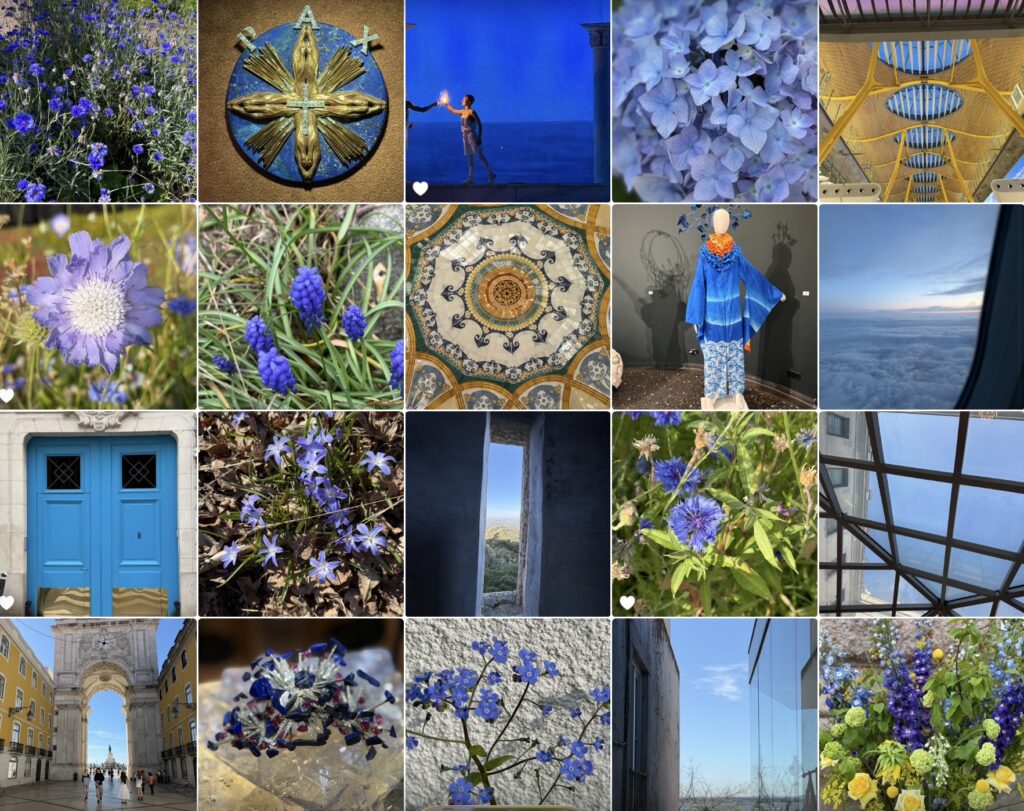
The photographic collection reveals a striking pattern. Although the images range from flowers and architectural details to landscapes, windows, doors, mosaics, and views from an aircraft, they repeatedly return to the same visual language.
Openings appear throughout the composition. A narrow stone passage frames the landscape beyond. A blue door suggests both separation and possibility. Windows create visual boundaries while simultaneously inviting the eye to move beyond them. Even the circular forms within mosaics and architectural details create a sense of movement and transition.
The natural world echoes these same themes. Flowers emerge among grasses, reaching toward the light, while the sea extends toward a horizon that remains permanently out of reach. The sky becomes another form of threshold, creating a space between what is visible and what remains beyond perception.
Viewed individually, the photographs appear unrelated. Viewed together, they reveal a remarkable coherence. The collection repeatedly directs attention toward movement, passage, and perspective. Blue becomes less a colour than a way of orienting the gaze.
Perhaps this explains why distance feels so central to the collection. The photographs rarely focus on enclosed spaces or final destinations. Instead, they concentrate on transitional spaces that encourage movement without revealing what lies beyond.
Looking for the infinite
The collection raises an intriguing question. Why is blue so frequently associated with the search for something beyond immediate experience?
Human beings have traditionally looked upward when searching for transcendence. The sky has long served as a metaphor for possibility, while the horizon has represented exploration and discovery. Yet one of the most compelling images in the collection is not the sky or the sea but a simple blue flower growing among grasses.
The juxtaposition changes the interpretation of the colour. Distance no longer belongs exclusively to vast landscapes or open skies. It becomes visible in something much smaller and much closer.
This shift in perspective challenges a deeply rooted assumption. Meaning is often imagined as something distant, something that must be pursued across geographical, intellectual, or spiritual horizons. Yet the collection suggests another possibility. The search for meaning may not always require movement toward what is far away. Sometimes it may require a closer examination of what already exists within the immediate world.
This interpretation resonates with artistic traditions that understand perception as an active process rather than a passive one. Art does not simply document reality; it transforms the relationship between the observer and the observed. The images within the collection encourage a different form of looking, one that values attention over acquisition and presence over distance.
Perhaps this is why blue has retained such a powerful symbolic presence throughout human history. It invites exploration while simultaneously encouraging stillness. It directs attention toward the horizon while reminding us to notice what exists under our feet.
An invitation
The photographs invite an exercise in observation. Which image attracts attention first? Is it the flower, the doorway, the sea, the window, or the sky?
The answer may reveal something about the way distance is understood. Some viewers may be drawn toward movement and travel, while others may respond to nature or architecture. Yet beneath these different responses lies a shared question that connects the entire collection.
Why do we so often look upward for the infinite when traces of it may already exist much closer to the earth?
About The Colour of Seeing
This essay is part of The Colour of Seeing, a series of photographic reflections exploring how colours shape perception, memory, emotions, and meaning. All photographs taken by Novisali.
Readers interested in the broader ideas behind the series are invited to begin with the introductory Story, which explores insights from colour psychology, design, philosophy, art, and contemporary research into how colours influence the way we experience the world.

Novisali crafts visual conversations that challenge perception and invite deeper reflection on the world we live in.