What Happens When People Can Ask Their Own Questions?
Four experiments in bringing art, cultural heritage and knowledge to life
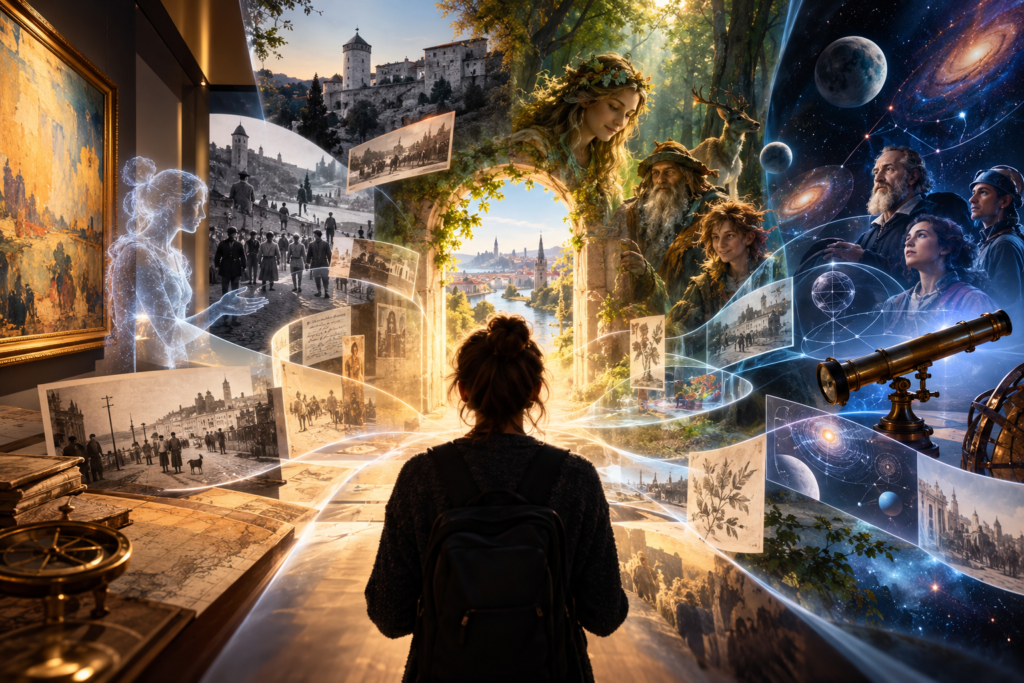
Imagine standing in front of an artwork, discovering an old photograph, or visiting a historic building. Something catches your attention. Perhaps it is a detail in the image, a story about someone who once lived there, or a question about what the place looked like centuries ago.
You might read the accompanying label, listen to a guide or search for more information. But what if the question that interests you most is not among those someone else has chosen to answer?
What if you could simply ask?
This seemingly simple possibility has become an increasingly important part of my work, both as an artist and in exploring how we can make art, cultural heritage and knowledge more accessible and engaging.
We live in a time when extraordinary amounts of material are available. Museums are digitising collections, archives are making historical documents searchable, artists are sharing their work online, and heritage organisations are preserving photographs, memories and stories that might otherwise disappear. Yet availability does not necessarily create engagement. Even when material is accessible, the experience often remains largely predetermined. Someone has decided what matters, how it should be explained and in which order we should encounter it.
I have become curious about what changes when we give people greater freedom to explore. Can we move from presenting information to inviting discovery? From looking at an object to engaging with the ideas, knowledge and stories around it? From receiving someone else’s answers to following our own questions?
Over the past few years, I have been investigating these possibilities through four related experiments. They have developed through my artistic practice, but their implications reach much further, into cultural heritage, historical archives, museums, science, education and other environments where valuable knowledge is waiting to be discovered.
It began with the power of reflection
My earliest experiments were not about artificial intelligence or digital technology. They grew out of experiences using art to help people reflect.
For several years, I have invited individuals and groups to engage with artworks as a starting point for exploring their own lives, leadership challenges, choices and possible futures. Rather than immediately discussing a problem, we begin by looking. What attracts our attention? What do we notice? What associations emerge? What might we be overlooking?
An artwork creates room for different interpretations. Two people can encounter the same image and see entirely different things, shaped by their experiences, expectations and circumstances. This is part of what makes art such a powerful starting point for reflection.
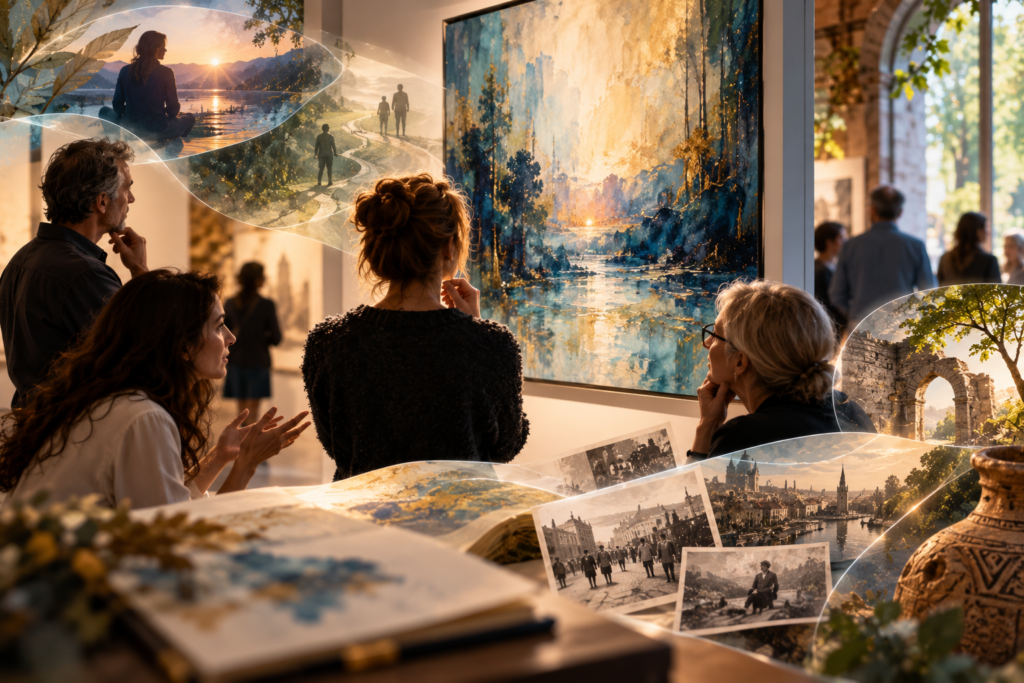
I have repeatedly experienced how these encounters can stimulate thoughtful and sometimes surprising conversations. More recently, I have experimented with developing a conversational agent art guide that can facilitate similar reflections without my being present.
The underlying question is whether a conversation, anchored in something we observe, can help us discover perspectives we might otherwise miss.
This is relevant not only to art. A historical photograph, a personal letter, an archaeological object or a place can also invite reflection. They can prompt questions about identity, belonging, change, memory and the relationship between past and present.
Sometimes the most meaningful discovery is not a new fact about an object, but a new understanding of ourselves through encountering it.
What lies beyond the visible?
A second line of experimentation emerged from my interest in extending the experience of a physical artwork.
At exhibitions in Halmstad, Stockholm, Madrid, Munich, Lissabon, Paris, Barcelona, and more recently Mapping the Unseen in Ljubljana, I have been exploring how visitors can discover additional dimensions of individual artworks through simple digital interactions.
Standing in front of a work, visitors can scan a code and enter an extension connected to that specific piece. The physical artwork remains central, but the experience does not have to end at its visible boundaries.
Unlike my later conversational experiments, this approach does not involve asking questions of a character. It is about extending what can be encountered and allowing visitors to decide whether to explore further.
Of my four experiments, this is the one for which I have the strongest measured engagement data. Across different exhibitions and settings, visitors have chosen to engage with the additional experiences, sometimes repeating them with curiosity and surprise.
These observations are encouraging, although they do not by themselves establish whether visitors develop a deeper understanding or a more lasting connection. Those are questions I want to investigate further.
The principle, however, has broader possibilities.
Imagine standing in front of an old photograph and being able to explore how the same location has changed over a century. Or encountering an archaeological object and discovering its origins, uses and connections to other cultures. A historic building might reveal different layers of its past, while a scientific illustration could open pathways into the discoveries behind it.
The object remains the anchor, but becomes a starting point rather than the limit of the experience.
When stories begin to answer back
My third experiment introduced a fundamentally different possibility: conversation.
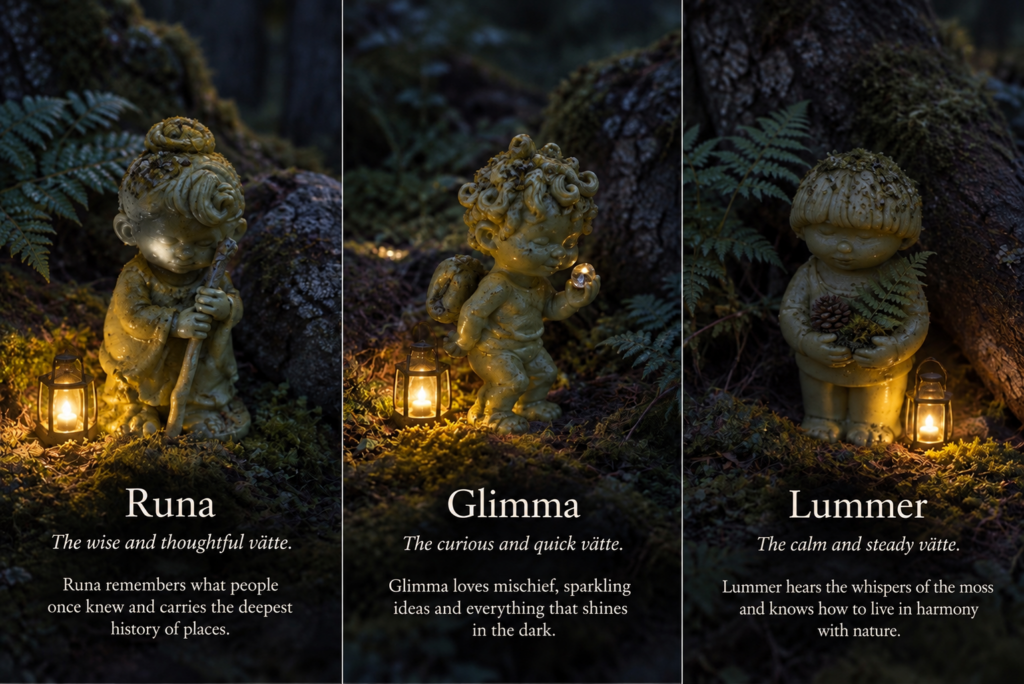
In Vättarnas Skymningsland (The Twilight Realm of the Hidden Folk), I created three characters — Runa, Glimma and Lummer — inspired by Swedish folklore and grounded in historical folklore archives.
Visitors can meet these characters through a simple code, without downloading an app or creating an account. They can choose whom to speak with and ask their own questions about the hidden folk, their relationship with nature, their traditions and their imagined world.
Instead of following a single predetermined narrative, visitors can explore different perspectives. One person might be interested in the origins of a particular folk belief. Another might want to understand how people once related to forests and supernatural beings. A child might ask what the hidden folk eat or where they sleep. The questions can take the experience in directions I might never have anticipated when designing an exhibition.
This introduces an important distinction between interaction and conversation. In an interactive experience, visitors may choose among possibilities that have already been designed. In a conversational experience, they can introduce questions of their own.
It also introduces the possibility of different voices. Runa, Glimma and Lummer are not simply three ways of presenting identical information. Their distinct personalities invite different relationships with the material.
For cultural heritage, this is particularly interesting. Historical knowledge is rarely a single, uncomplicated story. Places, traditions and events can be understood through different experiences and perspectives. A conversational approach may help make that richness more accessible, provided the differences between documented knowledge and creative storytelling remain clear.
I am still exploring whether characters encourage deeper engagement than other forms of interaction, which questions visitors choose to ask, and what makes them want to continue a conversation.
Connecting art, science and multiple perspectives
The fourth experiment brings several of these ideas together.
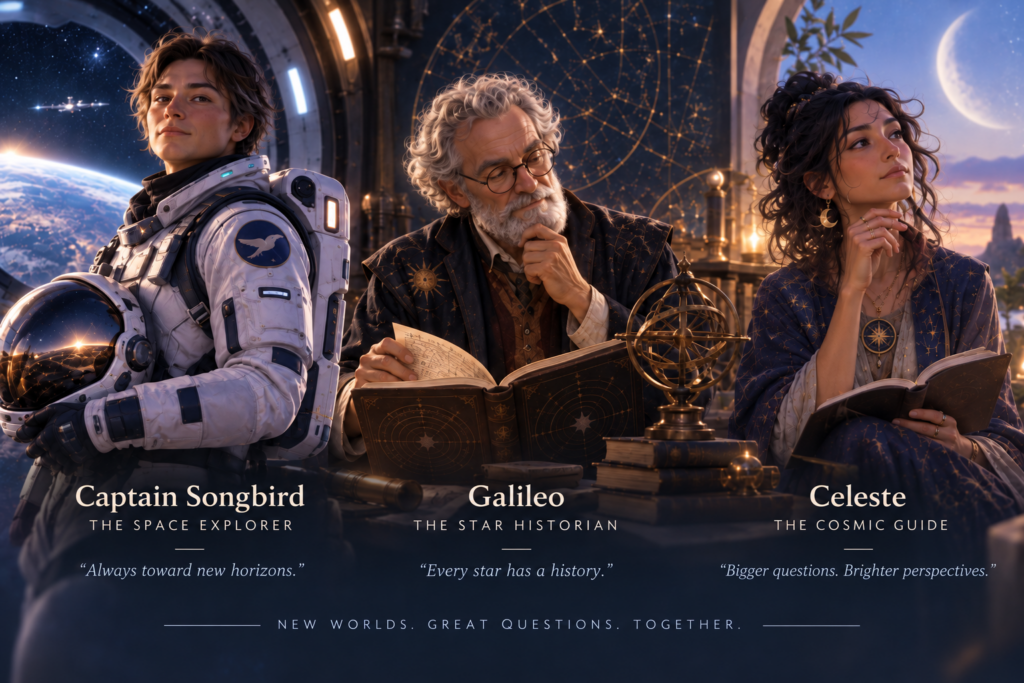
In Kosmiska Utflykter – Längs okända vägar (Cosmic Wanderings Along Unknown Paths), visitors can explore additional dimensions of artworks while also engaging in conversations with Kapten Fågelsång, Galileo and Celeste.
The characters draw on knowledge from astronomy and cosmology, while offering different personalities and perspectives on our relationship with the universe.
A visitor might begin with the visual experience of an artwork, become curious about a celestial phenomenon, and then ask Galileo about the discoveries that transformed our understanding of the cosmos. Another might turn toward more philosophical questions about uncertainty, exploration and the unknown.
Here, art becomes an entry point into scientific knowledge, while conversation allows people to pursue whatever captures their interest.
The experiment also raises a design question that I find increasingly important. Does combining visual interaction, knowledge and multiple conversational perspectives make an experience richer, or can it eventually become too complex?
We should not assume that adding more technology automatically improves engagement. Sometimes the simplest invitation may be the most effective. An intuitive way to begin, an intriguing question or an unexpected perspective may matter more than the sophistication of the underlying system.
The challenge is to make exploration feel natural, rather than turning it into another task visitors must learn to perform.
The more freedom we offer, the more important trust becomes
These experiments have also made me increasingly aware of a fundamental challenge.
When someone reads an exhibition label, the text has generally been researched, selected and edited in advance. When someone asks a conversational AI an unexpected question, the answer is generated in the moment. How do we know whether that answer is reliable?
For me, this is not a secondary technical issue. It is central to the integrity of the experience, particularly when working with historical material, scientific knowledge or cultural memory.
I have been developing the experiments around four distinctions: what is documented, what is interpreted, what is remembered and what is imagined.
Documented knowledge can be traced to identifiable sources. Interpretation draws meaning or conclusions from available evidence. Memories and oral histories offer valuable personal perspectives, although they may not always be independently verifiable. Imagination creates possibilities for artistic expression and storytelling without claiming to establish historical facts.
All four can have value, but they should not be confused. A fictional character can help visitors explore authentic folklore. A personal recollection can bring a historical photograph to life. An artistic interpretation can invite reflection on events that are otherwise difficult to understand. But the visitor should be able to recognise what kind of knowledge they are encountering.
This becomes particularly important when artificial intelligence makes experiences conversational and open-ended.
I have deliberately challenged my own conversational experiences with difficult questions, testing how they respond when sources are incomplete, when interpretation is required or when the answer is simply unknown. These tests help reveal weaknesses, but they are not a guarantee that every generated response will be accurate.
One of the insights emerging from this work is that the more freedom we give people to explore, the greater the discipline required in how we organise, ground and communicate the underlying knowledge.
What if curiosity became the way into a collection?
The possibilities become particularly interesting when we look beyond individual exhibitions.
Consider a local heritage society that has spent decades collecting photographs, letters, documents and personal memories. Its collection may contain extraordinary stories about how a community developed, how people lived and how major events shaped everyday life.
Some of this knowledge may already be digitised. Yet discovering it can still require knowing which names, dates or subjects to search for. A visitor might instead begin with a simple question: Who lived here before the railway arrived?
That could lead to photographs of the neighbourhood, accounts of local families, maps showing how the area changed and stories about the people whose lives were affected. Each answer could invite another question, with opportunities to examine the original sources.
Or imagine visiting Ljubljana Castle and wondering what existed on the hill before the medieval fortifications. Rather than receiving only a chronological overview, visitors could follow their curiosity through archaeology, settlement history, changing political powers and the evolving landscape.
An art gallery might invite visitors to explore the ideas, influences and techniques behind a work, while also allowing space for their own interpretations. A scientific collection might connect objects to discoveries, controversies and the people who shaped our understanding of the world.
These experiences need not all look alike. Some might use conversational characters. Others might offer direct access to source-grounded knowledge, visual exploration, guided reflection or a combination of approaches.
The common principle is that people can begin with what interests them, rather than needing to know how the collection has been organised.
This could make collections more approachable for new audiences, including children, international visitors and people who do not already possess specialist knowledge. Whether and how these possibilities translate into greater understanding, participation or long-term engagement remains something to test.
From experiments to Arcaiax Living Memory
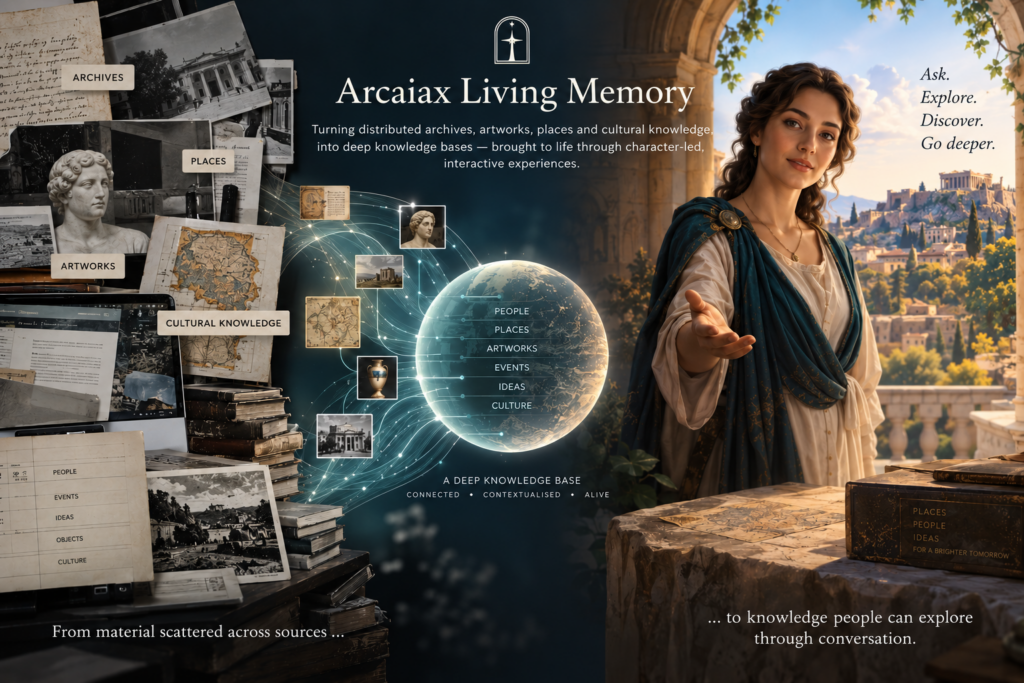
As these four experiments have developed, I have increasingly begun to consider how the approaches might be useful beyond my own artistic practice.
That thinking has led to Arcaiax Living Memory, an initiative exploring how existing knowledge, collections and stories can become more accessible through source-grounded interactive and conversational experiences.
My exhibitions provide a laboratory where I can test ideas directly with visitors, observe their responses and gradually improve the experience.
But the larger ambition is to explore whether the same principles can create value for organisations holding their own collections, histories and expertise. This might include museums, archives, heritage societies, galleries, historic places, scientific collections and organisations seeking to make institutional knowledge more accessible.
The aim is not to replace original sources, curators, historians, artists or guides. Their knowledge and judgement remain essential.
Rather, it is to explore how digital interaction and AI can create additional pathways into material that already exists, allowing more people to encounter it in ways that are meaningful to them.
The next important step is therefore not simply to create another engaging exhibition of my own. It is to collaborate with others and investigate how these approaches work with collections I do not control, audiences I do not already know and different definitions of value.
That transition will require new questions about source quality, curatorial responsibility, accessibility, visitor behaviour and how success should be measured.
What I am learning, and what I still want to discover
I am at different stages of learning across the four experiments.
The guided reflection work builds on several years of practical experience with individuals and groups. The digital artwork extensions have been tested across multiple exhibitions and provide the strongest measured engagement evidence. The character-led conversations and the combination of visual interaction with conversational exploration are newer experiments, where observations are still emerging.
I want to understand more about which questions people actually ask, what encourages them to continue exploring, how different interfaces affect participation and whether conversational experiences produce something meaningfully different from a well-designed exhibition label or conventional digital guide.
I am also interested in how multiple perspectives influence understanding, how visitors distinguish evidence from interpretation, and how experiences can remain accessible without becoming simplistic.
Perhaps most importantly, I want to explore what creates value for the organisations holding the material, not only for the people encountering it. For a museum, that might mean reaching new audiences or encouraging deeper engagement with a collection. For a heritage society, it might mean making decades of volunteer research more discoverable. For an artist, it might mean opening additional dimensions of a work. For a scientific or educational institution, it might mean helping people connect complex knowledge to questions they already care about.
Different contexts will require different approaches, and the value needs to be demonstrated rather than assumed.
Perhaps the most interesting stories begin with a question
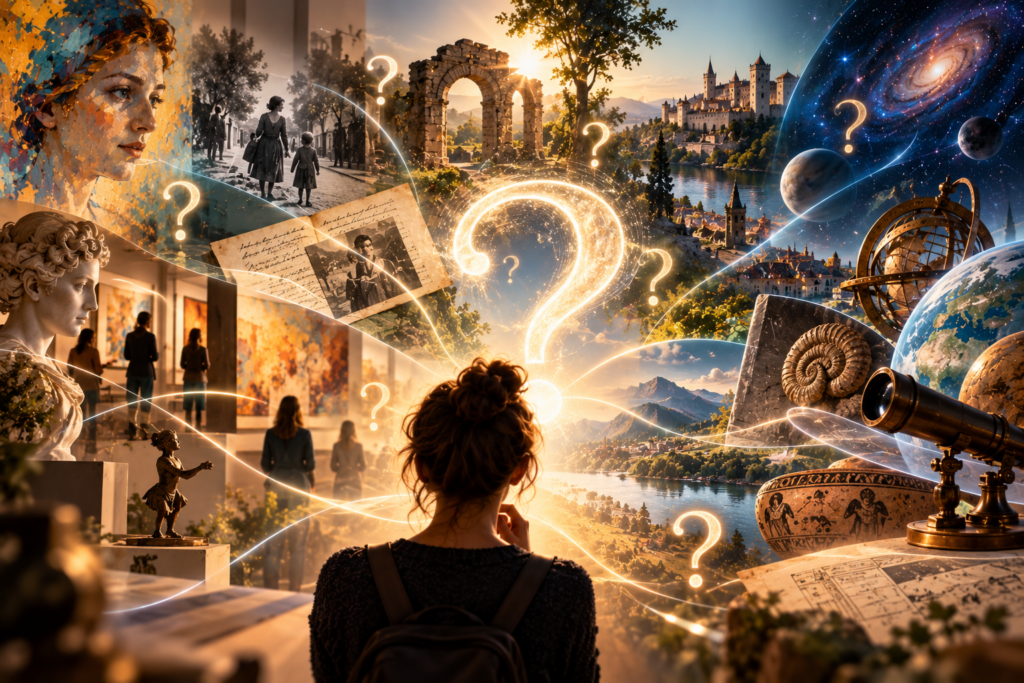
Art, cultural heritage and scientific knowledge have something important in common. They invite us to see beyond what is immediately in front of us.
An artwork can open a new perspective. A photograph can connect us to a life lived long ago. A historical place can reveal layers of change. A scientific object can lead us toward discoveries that transformed how we understand the world.
For centuries, artists, researchers, historians, curators and educators have helped us make these connections. New technologies offer additional possibilities, not by replacing their work, but by allowing more people to participate actively in the exploration. The most interesting change may not be technological at all. It may be a shift in who determines the path through knowledge.
Instead of only asking what we want people to see, read or learn, we can also ask what they are curious about. Instead of assuming one narrative will serve everyone, we can create opportunities for different questions and perspectives. And instead of treating an artwork, collection or historic place as the endpoint of an encounter, we can begin to see it as the opening of a much larger exploration.
Perhaps the future of an exhibition label is not simply a better label. Perhaps it is the beginning of a conversation.
And perhaps the future of making art, cultural heritage and knowledge accessible lies not only in what we choose to present, but in what we enable people to discover for themselves. Through Arcaiax Living Memory, I am looking forward to exploring these possibilities with others who care about bringing collections, places, knowledge and stories to life.
If you work with an archive, museum, cultural heritage organisation, gallery, historic place or another collection of knowledge, I would welcome a conversation.
What might people discover if they could begin with their own questions?
Let’s talk
If you hold material like this, I would be interested in exploring what could be brought to life — and what an experience would need to demonstrate to be valuable to you.
Liselotte Engstam
Arcaiax Living Memory / Novisali
Stockholm, Sweden
lise at novisali.com→
Arcaiax Living Memory is a live prototype — evolving through real-world experiences, one conversation at a time.