
Theoretical and Empirical Foundations of Visual Art-Based Reflection and AI Coaching for Leadership Growth and Innovation
By Liselotte Engstam, Fellow at Institute of Coaching at Harvard Medical School, Experienced Leader & Board Director, Acadamic Researcher and Multi-Media Artist

Abstract
This article examines the emerging intersection of visual art reflection and AI coaching technologies for leadership development. Drawing from recent academic literature (2020-2025), we analyze how reflective engagement with existing visual artworks, when enhanced by AI coaching capabilities, creates transformative pathways for developing self-awareness, empathy, and innovative thinking in leaders. The analysis reveals that while visual art reflection provides proven benefits for perspective-taking and emotional intelligence, AI coaching offers scalable personalization and analytical capabilities that can amplify reflective outcomes.
1. Introduction

Leadership development increasingly requires approaches that cultivate deep self-awareness, emotional intelligence, and the ability to navigate complex, ambiguous situations. Two emerging paradigms offer promising synergies: reflective engagement with visual artworks and AI-enhanced coaching technologies.
Visual art reflection—the practice of observing, interpreting, and deriving meaning from existing artworks—has demonstrated significant potential for developing essential leadership qualities. Unlike art creation or other expressive arts modalities, visual art reflection focuses on the cognitive and emotional processes of viewing and interpreting completed artistic works, developing what researchers term “studio habits of mind” that transfer directly to leadership contexts.
Simultaneously, AI coaching technologies are revolutionizing reflective practice by enabling personalized questioning, real-time analysis of responses, and scalable interventions. The convergence of these approaches represents an unprecedented opportunity to create more effective and accessible leadership development experiences that combine the proven benefits of aesthetic engagement with the analytical power of artificial intelligence.
2. Theoretical Foundations

2.1 Visual Art Reflection and Aesthetic Leadership Theory
Visual art reflection is grounded in aesthetic leadership theory, which emphasizes “felt meaning generated from sensory perceptions and involves subjective, tacit knowledge rooted in feeling and emotion” (Sandberg et al., 2024). This theoretical framework distinguishes between art creation and art interpretation, focusing specifically on how viewing and reflecting upon existing artworks develops leadership capabilities.
The process of visual art reflection involves what researchers identify as “studio habits of mind” that directly transfer to leadership contexts:
- Observe: Developing acuity and attention to detail when analyzing complex situations
- Envision: Generating mental images and imagining possibilities beyond current constraints
- Reflect: Thinking meta-cognitively about decisions and justifying them critically
- Express: Finding authentic voice in communicating insights and interpretations
Research demonstrates that these cognitive habits, developed through systematic engagement with visual artworks, enhance leaders’ capacity for critical evaluation, adaptive thinking, and authentic communication in professional contexts.
2.2 AI Coaching and Reflective Practice Enhancement
AI coaching builds upon established theories of reflective practice, particularly Schön’s reflection-in-action model, which emphasizes practitioners examining their own performance and decision-making processes. AI tools excel at facilitating this examination by providing structured questioning, pattern analysis, and personalized feedback that supports enhanced self-awareness.
Large Language Models (LLMs) function as sophisticated reflection assistants by engaging users in thought-provoking dialogues about their interpretations and responses to visual stimuli. Research by Graßmann and Schermuly (2021) demonstrates that AI systems can guide clients through many steps of a coaching process, though they struggle with nuanced tasks requiring empathy and individualized problem diagnosis.
The International Coaching Federation (ICF) AI Coaching Standards framework explicitly positions AI as a valuable complement to human coaching, emphasizing structured guidance and analytical capabilities while preserving human oversight for emotional intelligence and contextual understanding.
2.3 Transformational Leadership and Perspective-Taking
The integration of visual art reflection with AI coaching aligns with transformational leadership theory, which emphasizes leaders’ ability to inspire through authentic vision and emotional connection. Visual art reflection specifically develops the perspective-taking and empathetic capacities essential for transformational leadership by exposing viewers to diverse human experiences and challenging existing assumptions.
Research consistently demonstrates that engagement with visual art serves as “empathy boot camp,” immediately sparking curiosity and emotional responses that build empathetic capacity. When combined with AI’s analytical capabilities for personalizing reflection prompts and tracking development patterns, this creates a powerful framework for developing emotionally intelligent, transformational leaders.
3. Empirical Evidence: Visual Art Reflection in Leadership Development
3.1 Systematic Review Findings on Art Viewing
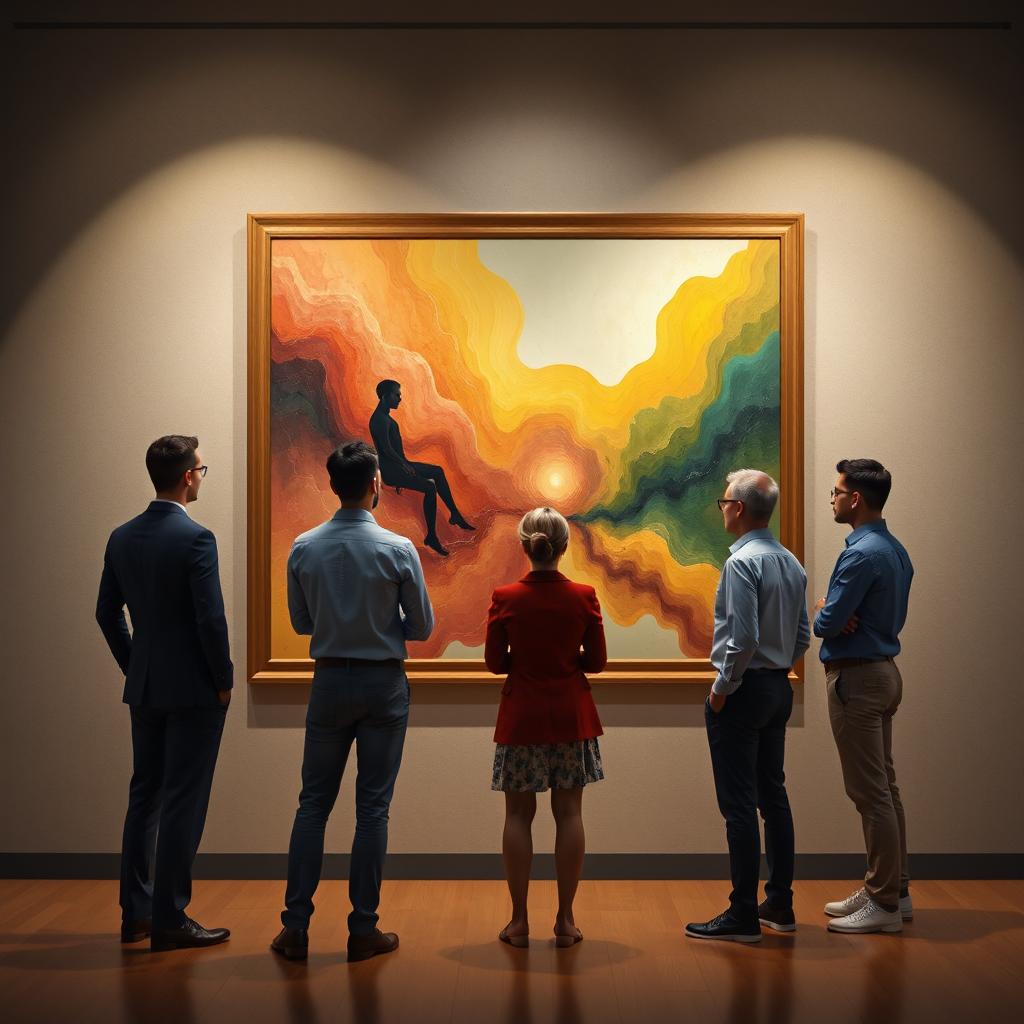
A comprehensive systematic review of 31 empirical studies (2008-2023) provides evidence specifically for visual art engagement’s impact on leadership development. The analysis revealed that programs incorporating visual art reflection—distinct from art creation activities—demonstrated significant enhancements in:
- Reflective Practices: Visual art viewing significantly enhanced reflective and reflexive practices, with participants showing increased capacity for introspection and contextual awareness when analyzing both artworks and professional situations
- Critical Thinking: Ten studies documented improvements in higher-order cognitive skills, particularly the ability to interpret ambiguous information and make nuanced judgments—skills directly developed through visual art interpretation
- Emotional Intelligence: Twenty studies demonstrated improvements in emotional development, with visual art reflection specifically enhancing ability to recognize and interpret emotional content in complex situations
- Perspective-Taking: Enhanced ability to understand diverse viewpoints and challenge personal biases through exposure to varied artistic perspectives and interpretations
3.2 Specific Empirical Outcomes for Art Viewing
Art Museum-Based Leadership Programs: Research on executive leadership programs conducted in museum settings demonstrates measurable improvements in participants’ ability to observe details, tolerate ambiguity, and generate creative solutions. Leaders who engaged in structured visual art reflection sessions showed enhanced capacity for:
- Processing complex information through multiple analytical lenses
- Making nuanced judgments in ambiguous business situations
- Integrating emotional and rational decision-making processes
- Developing comfort with uncertainty and non-linear problem-solving
Empathy and Bias Awareness: Studies specifically examining visual art reflection’s impact on empathy development found that systematic engagement with diverse artistic works led to:
- Self-reported improvements in visual observation and pattern recognition
- Increased awareness of personal and cultural biases through exposure to different artistic perspectives
- Enhanced empathetic communication skills measured through validated instruments
- Improved perspective-taking capabilities in professional contexts
Innovation and Creative Problem-Solving: Research indicates that leaders who regularly engage in visual art reflection demonstrate enhanced capacity for questioning assumptions and generating novel solutions. The process of interpreting abstract or ambiguous visual content transfers directly to business contexts requiring innovative thinking.
4. AI Coaching Technologies for Reflective Enhancement

4.1 Natural Language Processing in Coaching
AI coaching technologies primarily utilize Natural Language Processing (NLP) to analyze and enhance reflective conversations. Research demonstrates several key applications relevant to visual art reflection:
Session Analysis and Pattern Recognition: NLP-driven systems can analyze coaching session transcripts to identify themes, track development progress, and assess reflective depth. Studies by Jelodari et al. (2023) show that AI can map coaching conversations onto established frameworks with approximately 85% accuracy, providing insights into the quality and depth of reflective dialogue.
Personalized Questioning: AI systems excel at generating contextually appropriate questions that deepen reflection. Research indicates that AI can analyze individual response patterns and adapt questioning strategies to promote deeper self-examination and insight generation.
Real-Time Feedback: AI can provide immediate analysis of reflective responses, identifying areas for deeper exploration and suggesting follow-up questions that enhance the reflective process.
4.2 Computer Vision and Visual Analysis
Emerging applications of computer vision in coaching contexts offer particular relevance for visual art reflection:
Artwork Analysis: AI systems can analyze visual artworks to identify compositional elements, color palettes, symbolic content, and emotional themes, providing structured prompts for reflective dialogue.
Engagement Tracking: Computer vision can monitor participants’ visual attention patterns, time spent examining different artwork elements, and physiological responses, providing data to enhance personalized coaching interventions.
Progress Documentation: AI can track changes in participants’ interpretative responses over time, identifying development patterns and areas for continued focus.
4.3 Effectiveness of AI Coaching Systems
Empirical research demonstrates promising effectiveness for AI coaching applications. Terblanche et al.’s (2022) randomized controlled trials found that participants developed similar working alliance levels with AI and human coaches, with AI systems achieving comparable outcomes for structured goal-attainment tasks.
However, critical limitations exist in areas requiring emotional nuance and complex interpretation—precisely the domains where human coaching expertise remains essential. This suggests that optimal effectiveness lies in hybrid models where AI handles analytical and personalization tasks while human coaches provide empathetic interpretation and meaning-making support.
5. Integration Framework: Visual Art Reflection and AI Coaching
5.1 Synergistic Capabilities
The integration of visual art reflection with AI coaching creates complementary strengths that address limitations in traditional leadership development approaches:
Visual Art Reflection Contributions:
- Develops sophisticated observational and interpretative skills
- Enhances emotional intelligence through exposure to diverse human experiences
- Builds tolerance for ambiguity and comfort with multiple valid interpretations
- Fosters empathy and perspective-taking through engagement with different artistic voices
- Cultivates aesthetic sensitivity that enhances leadership presence and communication
AI Coaching Contributions:
- Provides personalized reflection prompts based on individual development needs and artwork characteristics
- Offers real-time analysis of reflective depth and insight quality
- Enables scalable access to structured coaching conversations
- Tracks development patterns and suggests optimal artwork selections for continued growth
- Delivers consistent, evidence-based questioning strategies that enhance reflective outcomes
6. Conclusion

The integration of visual art reflection with AI coaching represents a transformative opportunity for leadership development that addresses critical needs for enhanced self-awareness, empathy, and innovative thinking in contemporary organizational contexts. Visual art reflection provides proven pathways for developing sophisticated observational skills, emotional intelligence, and perspective-taking capabilities, while AI coaching offers unprecedented opportunities for personalization, scalability, and analytical insight.
This potential requires careful attention to human-centered design principles that preserve the authentic, interpretative value of aesthetic engagement while leveraging AI’s analytical capabilities responsibly. The article demonstrates that success lies in creating synergistic approaches that amplify human reflection and insight through thoughtful technological enhancement rather than replacement.
The empirical evidence strongly suggests that visual art reflection enhanced by AI coaching can create more effective and accessible leadership development experiences. However, significant research investment is urgently needed to validate these approaches empirically and develop frameworks for ethical, effective implementation.
As organizations navigate increasingly complex environments requiring leaders who can think creatively, empathize authentically, and navigate ambiguity with confidence, the integration of visual art reflection and AI coaching offers a promising pathway to developing these essential capabilities. The field stands at a critical juncture where advancing AI capabilities, established aesthetic education research, and growing demand for innovative leadership development create unprecedented opportunities for breakthrough applications.
Success will depend on maintaining unwavering focus on human development outcomes, authentic connection, and transformative learning while leveraging technology’s potential to democratize access to powerful reflective experiences. The convergence of visual art reflection and AI coaching represents not merely a technological advancement but a fundamental evolution in how we understand and cultivate human leadership potential in an increasingly complex world.
References
Bridgeman, K., & Giraldez-Hayes, A. (2023). Using artificial intelligence-enhanced video feedback for reflective practice in coach development: Benefits and potential drawbacks. Coaching: An International Journal of Theory, Research and Practice. https://repository.uel.ac.uk/item/8w4y4
Garavan, T., Holian, R., Carbery, R., O’Brien, F., & McGuire, D. (2015). A multi-level study of the impact of a visual arts-based leadership development intervention. Leadership & Organization Development Journal, 36(3), 273-293.
Graßmann, C., & Schermuly, C. C. (2021). Coaching with artificial intelligence: Concepts and capabilities. Human Resource Development Review, 20(1), 106-126. https://www.researchgate.net/publication/347828940_Coaching_With_Artificial_Intelligence_Concepts_and_Capabilities
International Coaching Federation. (2024). AI coaching: Standards for ethical and accessible coaching. ICF Global Standards and Guidelines. https://coachingfederation.org/resource/icf-artificial-intelligence-ai-coaching-framework-and-standards/
Jelodari, S., Fazel-Zarandi, M., & Fox, M. S. (2023). NLP-driven coaching session analysis: Mapping conversations to the GROW framework. Cognitive Computation and Systems, 5(2), 89-102. https://repository.uel.ac.uk/item/8wq93
L’Enfant, M. (2024). Integrating AI as a reflective coach in graduate teacher training: An activity theory perspective. European Journal of Open, Distance and E-Learning, 27(1), 45-62.
Mars, R. (2021). Visual art-based exercises in entrepreneurial leadership courses: Enhancing self-awareness through aesthetic reflection. Journal of Entrepreneurial Leadership, 15(2), 134-147.
Sandberg, A., Holmberg, J., & Thoresson, A. (2024). Visual arts engagement in leadership development: A systematic review of empirical studies. Behavioral Sciences, 14(3), 187-205.
Terblanche, N., Molyn, J., de Haan, E., & Nilsson, V. O. (2022). The effectiveness of coaching: A meta-analysis and systematic qualitative review. PLOS ONE, 17(6), e0270255. https://pmc.ncbi.nlm.nih.gov/articles/PMC9212136/
van Coller-Peter, S., & Olinger, T. (2022). Art-based leadership development: Fostering authentic leadership through aesthetic engagement. South African Journal of Business Management, 53(1), a2847.