Patterns and Forms
We meet them everywhere—
in the spiral of a shell,
the rhythm of footsteps,
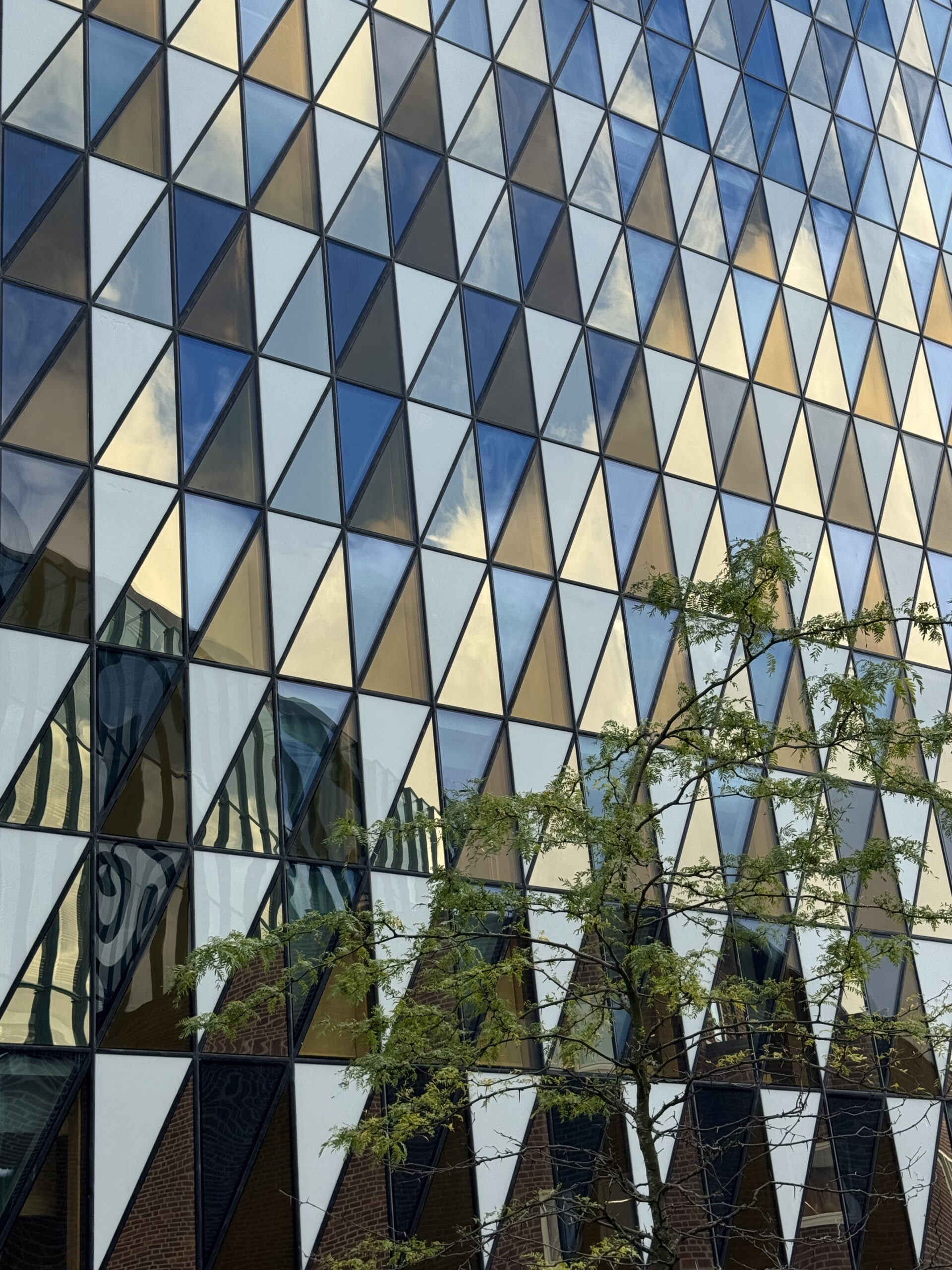
the geometry of a window.
They whisper of hidden order,
yet invite us to break and reshape them.
Perhaps that’s where beauty begins—
between the repetition and the surprise.
Nature-Inspired Patterns

Look closely at the natural world and you’ll see that it’s built on repetition and rhythm. Spirals unfurl in seashells, sunflowers, and pinecones, echoing the same geometry we find in swirling galaxies. Fractals shape the branching of trees, the veins of leaves, and even the network of rivers seen from above.

Mathematicians call it the Fibonacci sequence, a numerical rhythm where each number is the sum of the two before. Designers and architects have long borrowed this sequence to create harmony that feels both intentional and organic.
Perhaps we’re drawn to these forms because they echo a hidden order of the universe, reminding us that beauty often lies in repetition dressed in endless variation.

Patterns in Human Creativity
Just as nature repeats, so too does human creativity. Textiles reveal centuries-old weaves of rhythm and motif. Architecture rests on repeated arches, columns, and lattices. Music, too, is a play of recurring notes and pauses, where repetition creates harmony and variation adds life.
Across cultures, patterns are visual languages. In Islamic art, geometric designs honor infinity and balance. African weaving carries stories and heritage within its repeating motifs. Nordic folk designs transform simple stitches into snowflake-like forms passed down through generations.


It leads us to wonder: do patterns connect us across cultures more than we realize?
Forms as Symbols
Beyond their beauty, forms carry meaning. A circle suggests wholeness and eternity. A triangle stands for stability or the sacred. A spiral embodies growth, evolution, and journey.
Artists and thinkers have long relied on these shapes to explore profound ideas. Kandinsky saw shapes as vessels of emotion and spiritual resonance. Hilma af Klint used spirals and abstract geometry to express mystical truths. The Bauhaus movement reduced design to circles, squares, and triangles—believing that simplicity could convey universality.
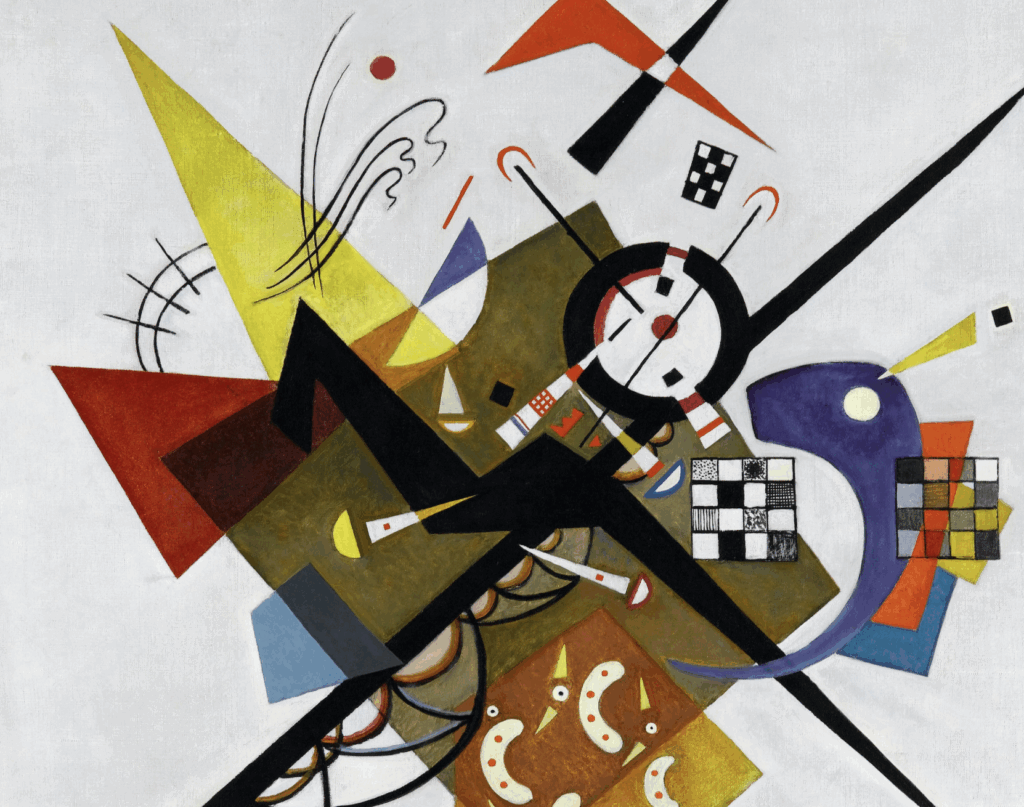

Forms, it seems, are not only seen but also felt.
Breaking the Pattern
Yet there comes a moment when patterns become predictable, even confining. Innovation often arises not from repeating, but from breaking.
Think of the beauty in cracked pottery, where the imperfection becomes the focal point. Or in irregular brushstrokes, where chaos interrupts harmony. Jazz musicians thrive on improvisation—playing with the pattern until it transforms into something unrepeatable.

Sometimes the beauty lies not in the form, but in the fracture.
Patterns Through My Lens
As part of my weekly photography and composition practice, I set out to capture a catch of intriguing patterns and forms. These moments, discovered almost by chance, reveal how much rhythm and surprise surrounds us when we look closely.
Torsplan – (picture 1) Even in something as ordinary as the design of a tower entrance and its intercom, I found rhythm and repetition. These small discoveries remind me that patterns are everywhere, not just in grand designs, but also in thresholds we pass each day.
Helix Tower, 16th floor and Helix Art Place – (picture 2) By happy accident, we entered a closed exhibition by Jesper Blom. His art filled the space with surprise, especially a painted window depicting a Swedish-Indian version of midsummer, framed by a view over the Karolinska area. From above, I also noticed the running track hidden on a rooftop—a pattern of movement stitched into the cityscape.
Forskaren, seen from Park Norra stationsparken – (picture 3) The large leaf and plant sculptures caught my attention. Both playful and monumental, they form a sheltering canopy for a seating area, reminding me that patterns in architecture can invite rest as well as admiration.
Karolinska Institutet, Aula Medica foyer – (picture 4) A digital waterfall, Falling Water, flows against a starry installation of 95 hand-cut crystal cones by professor Ingegerd Råman. Through my lens, the movement of water and the geometry of light became a dialogue between nature and design.


Through this weekly lens, I’ve come to see patterns as both a personal practice and a universal language—a way of noticing the world that deepens my creativity and connection.
An Invitation to Notice
Patterns and forms aren’t just distant concepts—they live in our daily lives. The way light casts through a window at a certain hour. The routes we unconsciously walk each day. The rhythm of conversation with a friend.

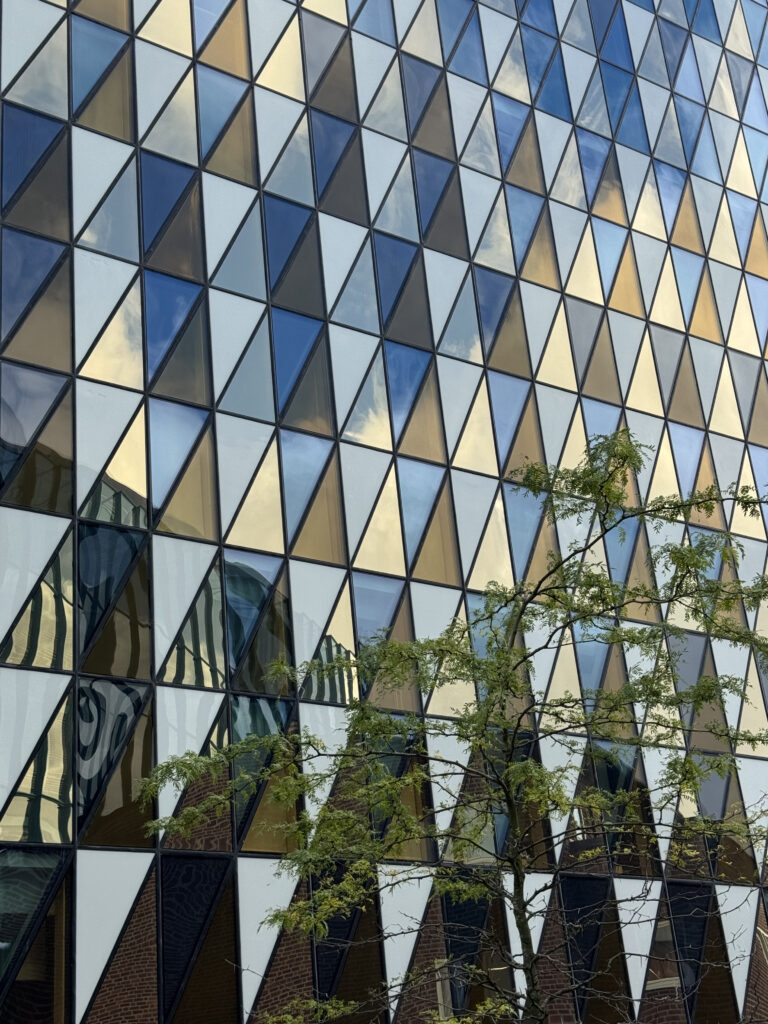
I invite you to notice these patterns. Photograph them, sketch them, or simply pause to recognize them. In doing so, you may discover that life itself is a canvas of repetition and surprise, a dance of forms waiting to be seen.
Closing Thought

Patterns and forms are more than shapes and structures—they are the hidden language around us. They remind us that we live within a universe of rhythm, resonance, and renewal. And perhaps the truest art is to notice them, honor them, and sometimes, dare to break them.
About Novisali
Novisali, (alias Liselotte Engstam), is besides her roles as professional board member and advisor, a multi-media artist, with a curious, explorative mind and an ambition to learn and extend art experiences to current and new audiences using both traditional and new digital mediums. More information and exhibitions can be found via Novisali.com
This blog post is also shared at the blog of www.liselotteengstam.com, with the artist name Novisali.