Art, AI, and Human Agency in Times of Uncertainty
Hope is often misunderstood.
We tend to speak about hope as something that belongs to the future — something that will arrive when uncertainty disappears, when problems are solved, when clarity returns. Hope becomes a reward waiting at the end of difficulty. But the world we inhabit today does not easily allow for that kind of hope.
Across economic, technological, and societal domains, uncertainty has shifted from being an interruption to becoming a condition. Work emerging from the World Economic Forum increasingly describes volatility, complexity, and systemic interdependence as structural realities rather than temporary disruptions. The question is no longer how to predict the future accurately, but how to remain capable of acting meaningfully without certainty.
This is where hope changes meaning. Not as a promise. But as a practice.
Hope is not optimism — and not prediction
Optimism assumes that things will turn out well. Prediction assumes that we can foresee what lies ahead. Hope requires neither.
Leadership and organisational research, including discussions in INSEAD Knowledge, increasingly emphasises the importance of holding paradox — the ability to remain inside tension without rushing toward premature resolution. Creativity and innovation often emerge when ambiguity is engaged with rather than avoided.
Hope lives in this space. It does not say everything will be fine. It says something meaningful can still be done from here.
This distinction matters. Optimism disappears when conditions worsen. Hope, when practiced, remains available even in ambiguity.
AI, imagination, and human agency
Artificial intelligence intensifies this tension. AI improves prediction and optimisation, yet it also reveals how limited prediction remains in complex human systems. The future becomes increasingly shaped by interaction rather than forecast.
Research from the Institute for the Future and futurist Jane McGonigal reframes this challenge in an important way. Rather than attempting to predict a single future, people and organisations benefit from practicing multiple possible futures. Imagining different scenarios strengthens resilience, reduces anxiety, and increases agency because individuals feel better prepared to respond to change.
Hope, in this sense, is not passive expectation. It is an active capacity to imagine alternatives and remain engaged with shaping them. This aligns deeply with artistic practice. Art does not forecast the future; it expands the range of futures we can imagine ourselves inhabiting.
The neuroscience of uncertainty & creativity
Neuroscience helps explain why this matters. Uncertainty activates threat responses in the brain. We seek closure, explanation, and control. Yet creativity research shows that uncertainty also creates the conditions for new insight. What researchers describe as “psychological entropy” can generate anxiety, but when explored rather than avoided, it becomes the starting point for meaning-making and creative reorganisation.
Art interrupts the impulse toward immediate resolution. When we engage with art that does not resolve itself immediately, the brain shifts from problem-solving into exploration. Multiple interpretations can coexist. The need to conclude softens. Instead of closing uncertainty, we learn to remain present within it. In this sense, art becomes a training ground for hope.
Art as a space that holds uncertainty
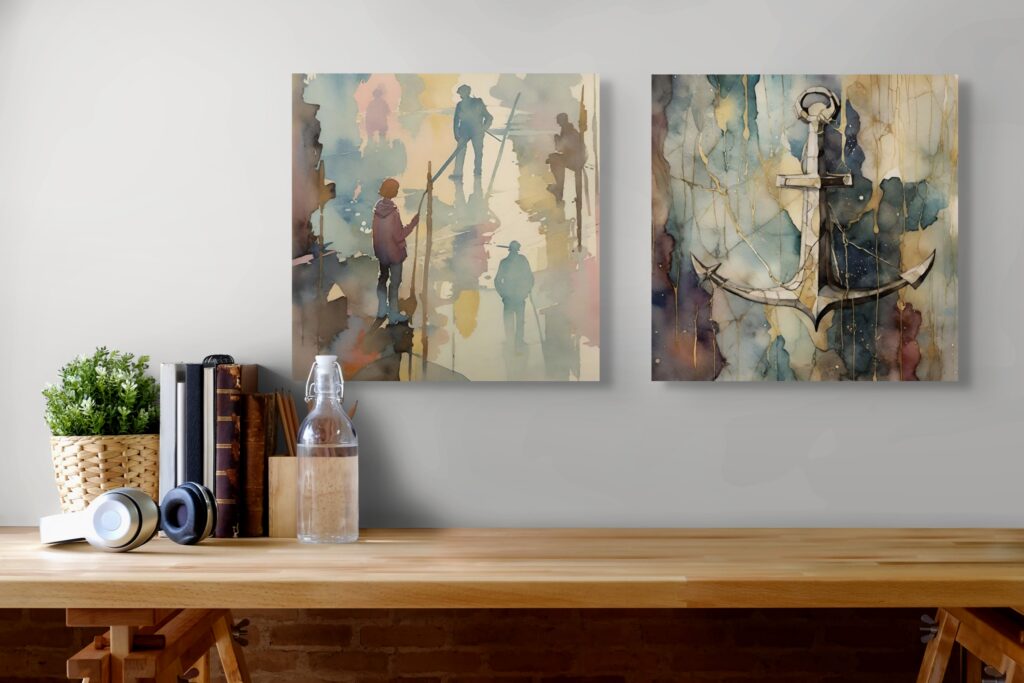
In my series Hopepunk, Human Cartography, and Sparks of Hope, I explore how hope moves between present experience and future imagination. The works do not attempt to predict the future, but to make space for imagining and inhabiting more hopeful directions from where we stand today.
Each series approaches this differently. Hopepunk explores hope as an active stance — a quiet resistance against cynicism and disengagement. Human Cartography maps inner and relational landscapes, tracing how individuals orient themselves in times of change. Sparks of Hope focuses on moments of emergence — small signals of possibility that allow movement to begin again.
The artworks function as maps rather than answers. A map does not remove uncertainty. It helps us orient ourselves within it. Through layering — watercolor, digital reinvention, and interactive extensions — the work reflects a world where meaning unfolds over time. Interpretation changes as the viewer changes. The artwork becomes less an object and more a meeting place between perception, imagination, and reflection.
Art here does not resolve uncertainty. It holds it long enough for something else to emerge: attention, orientation, and the recognition that hope can exist even before certainty appears.
Hope as a present-day practice
Across contemporary cultural writing — from leadership discourse to long-form essays such as those explored in The Atlantic and The Marginalian — hope is increasingly described not as naive positivity but as an active stance. A decision to remain in relationship with the world even when outcomes remain unclear.
Mapping hope means asking:
- What do I remain in relationship with?
- What still matters enough to care for?
- Where can agency exist, even in small forms?
Hope practiced this way becomes sustainable. It does not depend on certainty or success. It grows through attention, imagination, and continuation.
Mapping hope to remain human
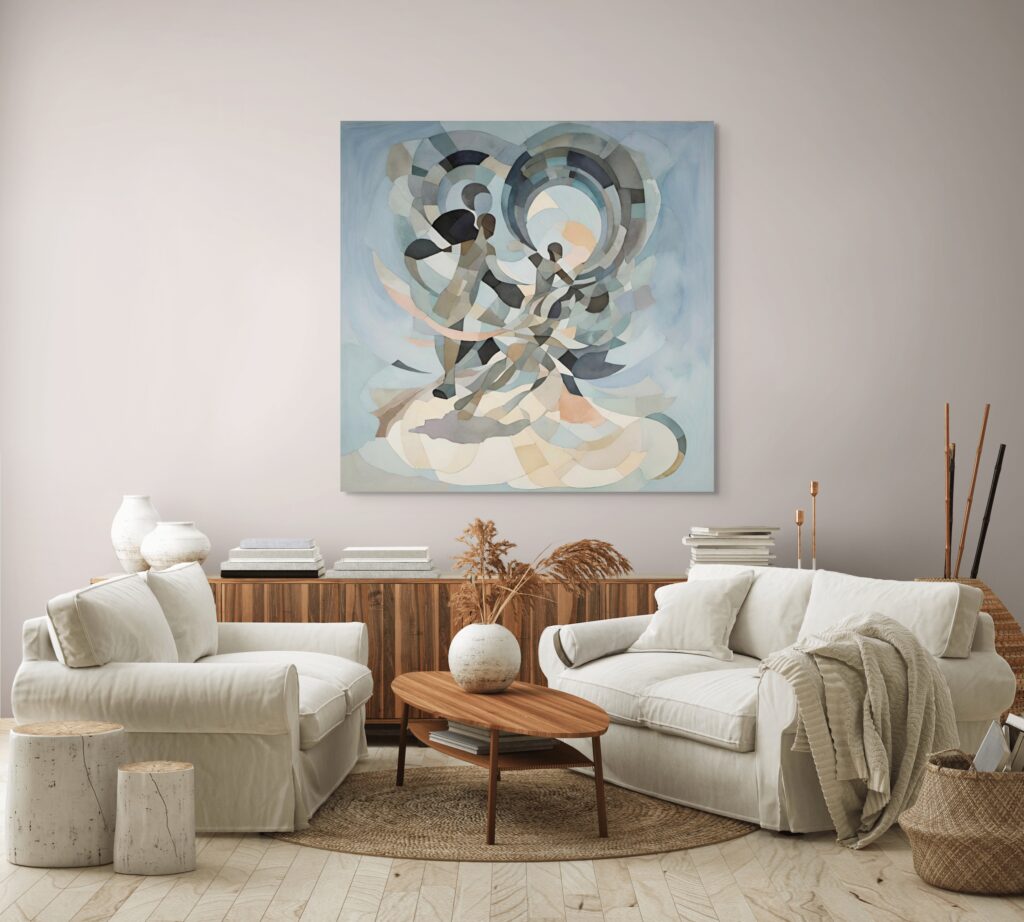
When I say that I work with mapping hope as a present-day practice, I mean that hope is something we enact through orientation rather than expectation.
Hope does not eliminate uncertainty. It gives us a way to stay present inside it.
In an age shaped by artificial intelligence and accelerating change, this may be one of art’s most important roles — not to predict the future, but to help us remain human while it unfolds.
Mapping hope beyond the studio
Over time, through observing leaders, teams, and people navigating uncertainty, the focus of Mapping Hope began to take shape in my artistic work.
In conversations around difficult decisions, transformation, and change, I repeatedly encountered the same challenge. The difficulty was rarely a lack of information. It was the absence of orientation — how to move forward without certainty, how to remain connected to what matters when outcomes were unclear, and how to sustain agency in complex situations.
These observations gradually found their way into the studio. Art became a space where these questions could be explored more slowly and more openly. Where uncertainty did not need to be resolved immediately, and where imagination and reflection could coexist. The artworks became maps rather than answers — ways of making visible the process of staying present while moving forward.
In this sense, art and leadership meet in a shared territory. Both require attention, judgment, and the willingness to act without complete clarity. Mapping hope, then, is not about optimism. It is a practice of orientation — a way of continuing to engage, to care, and to shape what comes next while the future remains open.
Perhaps hope was never something waiting for us in the future, but something we practice in how we meet the present.
Further Reading & References
- World Economic Forum — leadership and uncertainty
- INSEAD Knowledge — paradox mindset and creativity
- Institute for the Future & Jane McGonigal — imagination and future thinking
- Neuroscience & creativity research
- The Marginalian — creativity and meaning
Art Exhibition
If these reflections speak to you, I would love to welcome you into the physical space where Mapping Hope lives and breathes.
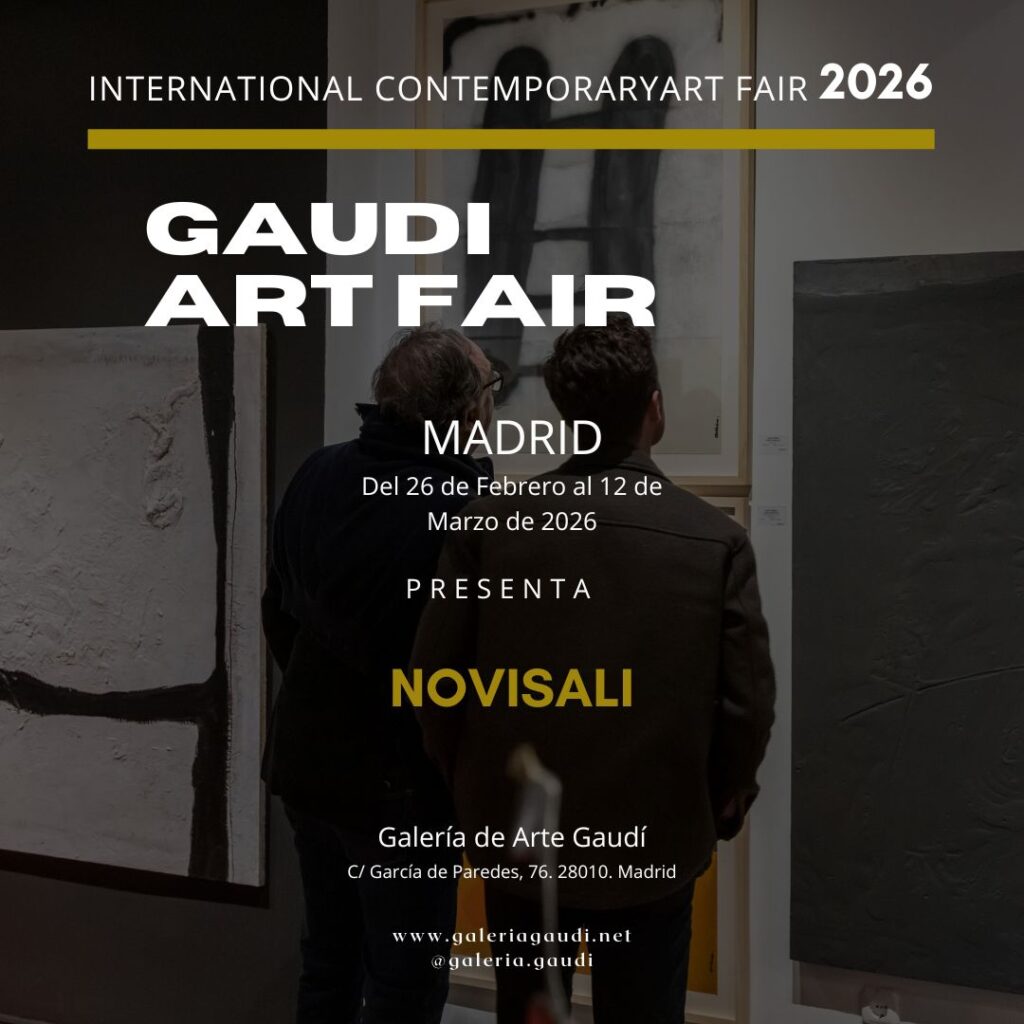
Mapping Hope at
Gaudí Art Fair 2026
Galería de Arte Gaudí
C/ García de Paredes 76
28010 Madrid, Spain
February 26 – March 12, 2026
(Novisali will be present in Madrid March 7–12)
Presented during Madrid’s contemporary art week alongside ARCO Madrid and the city’s international art program. Come meet the artists, experience the works up close, and explore the digital extensions that bring each piece to life.
About Novisali
Novisali, (alias Liselotte Engstam), is besides her roles as professional board member and advisor, a multi-media artist, with a curious, explorative mind and an ambition to learn and extend art experiences to current and new audiences using both traditional and new digital mediums. More information and exhibitions can be found via Novisali.com

This blog post was is also shared at the blog of www.liselotteengstam.com, with the artist name Novisali.