
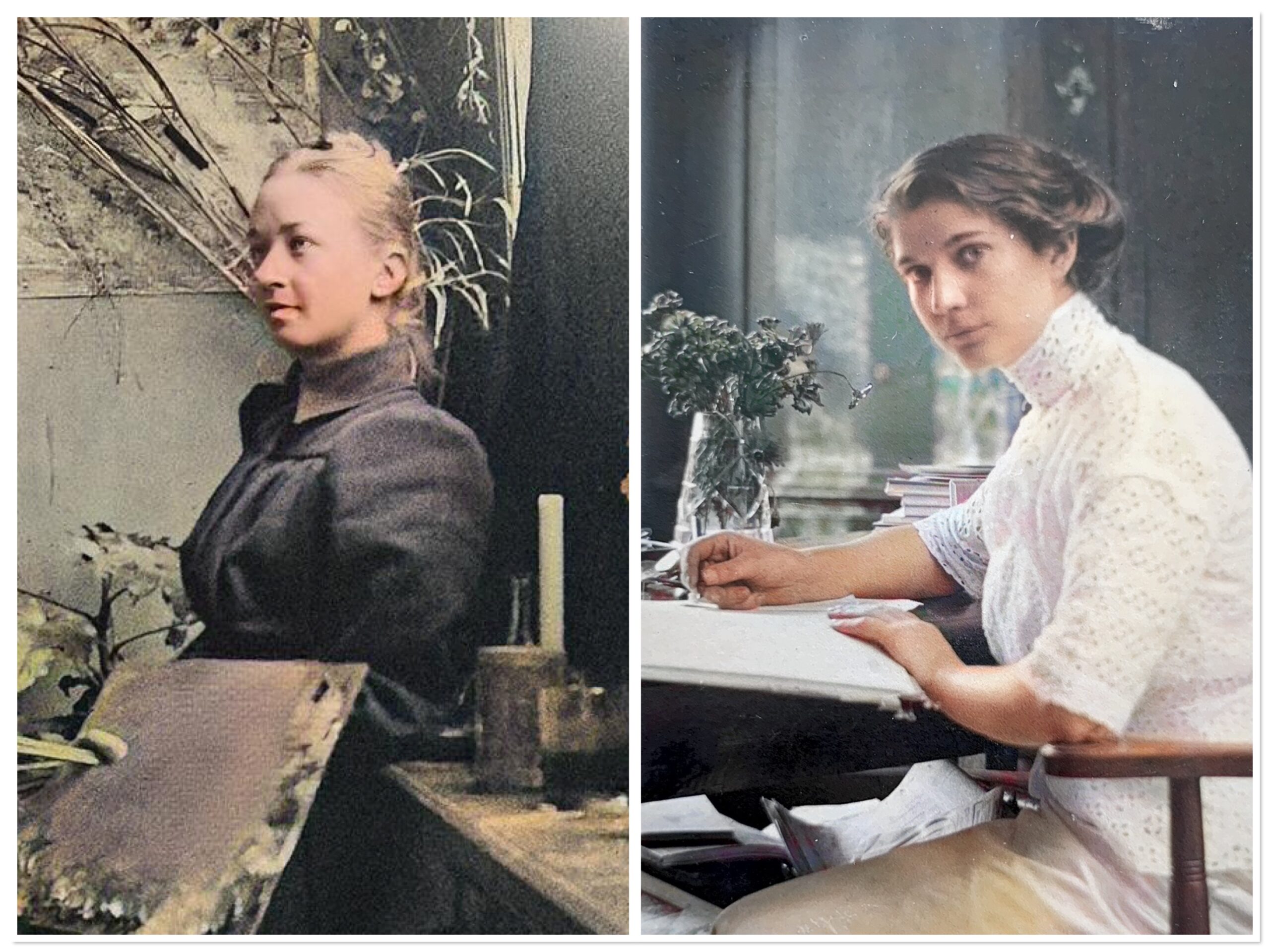
A Conversation Imagined, A Connection Felt
(Läs denna blogpost på svenska HÄR)
As both an artist and someone deeply curious about how we carry and translate meaning across time, I’ve long felt a quiet kinship with women like Engla Hägertz, my fathers aunt, and Hilma af Klint—creators who saw the world not only as it appeared, but as it might become.
This project is an offering. A poetic reconstruction. A meditation on what might have been said, if two visionary women—one with a camera, one with a brush—had found one another across their parallel paths in early 20th-century Sweden.
It is also an invitation to reflect on the unseen threads that connect us across generations, disciplines, and silences. In these imagined letters, I hear echoes of my own creative questions—and perhaps you will too.
— Novisali
Parallel Lives, kindred visions
Engla Hägertz (1890–1974) and Hilma af Klint (1862–1944) lived in the same country during overlapping decades, yet belonged to different spheres of the Swedish art world. One wielded a camera. The other, a brush. Neither sought fame. Both pursued truth.
Engla Hägertz
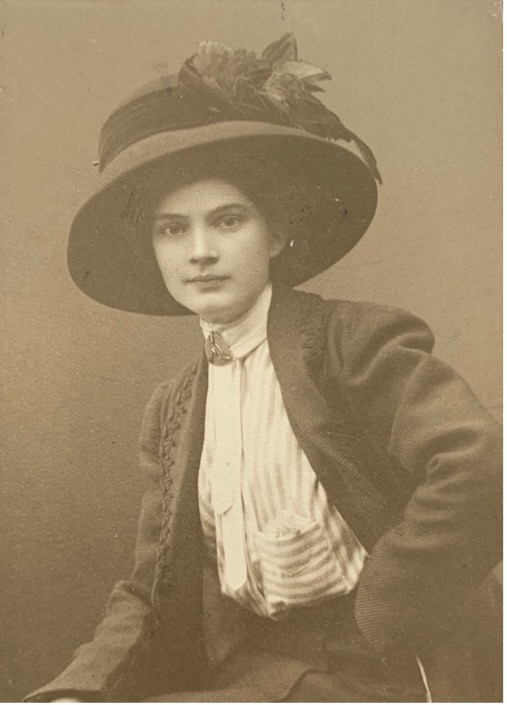
Engla was a female photographer and studio owner in Oskarström, a small industrial town in Halland, Sweden. Together with her sister Gudrun, she opened her first studio in 1914, capturing portraits of townspeople, laborers, and local families. She also photographed nature—especially flowers—and later created and sold hand-printed botanical postcards. Her work, though often practical, radiated empathy and compositional clarity. She saw light not just as illumination, but as revelation.
Hilma af Klint
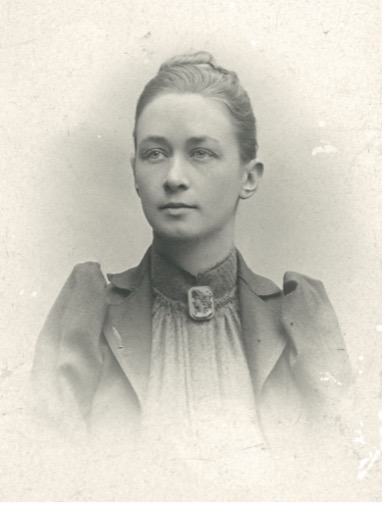
Hilma, meanwhile, painted in silence. Her early career followed conventional routes—portraits, landscapes, botanical and scientific illustrations. She studied at the Royal Academy of Fine Arts in Stockholm (1882–1887), where she was one of the first women admitted. After graduation, she lived and worked primarily in Stockholm, where she built a modest career as a traditional painter.
But in 1906, guided by spiritual experiences and communications she believed came from higher realms, she embarked on a radical new path. She began creating abstract paintings—geometric, symbolic, visionary works that preceded Kandinsky’s by several years. These would later become known as the “Paintings for the Temple,” and marked her turn away from the visible world toward an art of inner revelation. She believed the world wasn’t yet ready to understand them.
Though no evidence suggests they ever met, their lives unfolded in quiet parallel. They were unmarried, independent, deeply spiritual, and creatively driven—women who built careers on their own terms in a time that offered them few models. Both cultivated beauty from the everyday. Both listened for something beyond the visible.
If They Had Met: A Likely Conversation
Imagine Engla reaching out in admiration—perhaps after hearing whispers of Hilma’s strange and beautiful paintings through artist friends in Halmstad or Gothenburg. She might have asked how to stay true to a vision the world didn’t yet understand. Hilma, decades older but similarly solitary, might have written back with gentle encouragement: urging Engla to trust the unseen, to follow the light not just in her subjects, but within herself.
Their letters would not be loud. They would be slow, thoughtful, and quietly transformative—like the way spring sunlight moves across a wooden floor. They would speak of loss and courage, of nature and mystery, of photography as memory and painting as revelation.
And though their mediums differed, their messages would harmonize:
See deeply. Create faithfully. Trust what others cannot yet see.
Letters between Engla Hägertz and Hilma af Klint
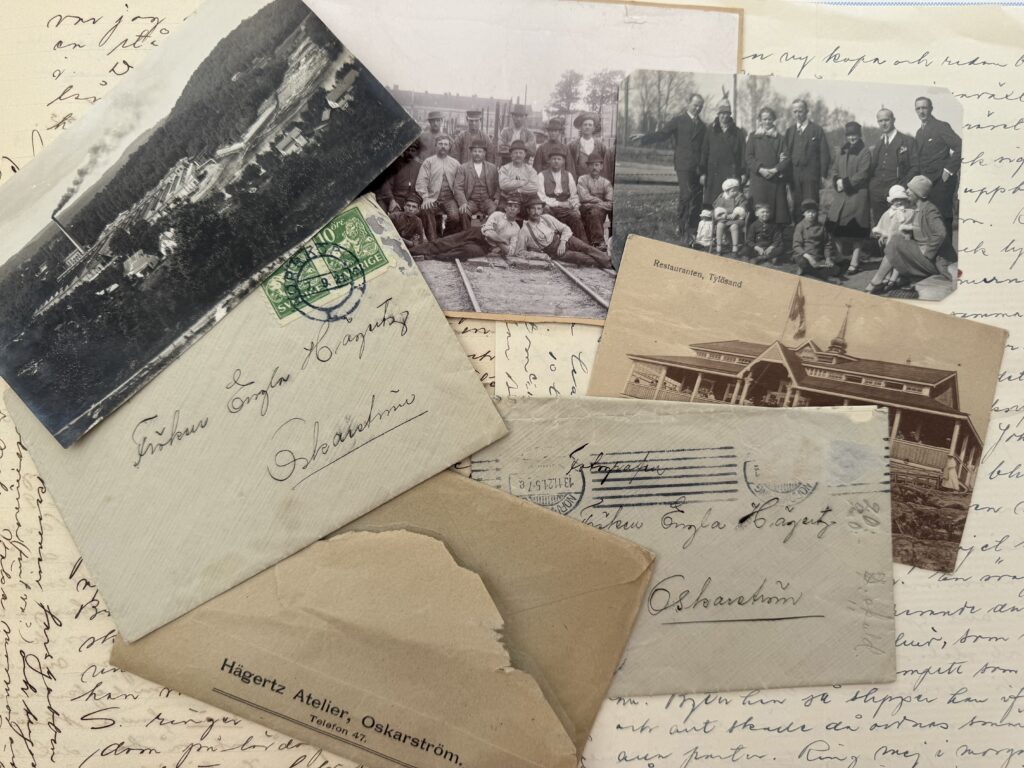
Letter 1: March 1914
Engla (24) → Hilma (51)
From Bruksgatan, Oskarström – To Brahegatan, Stockholm
Dear Miss af Klint,
I hope this letter finds you well. I write with humble admiration and genuine curiosity. My name is Engla Hägertz, and my sister and I have just acquired our first photography studio in Oskarström. We are two women, newly in charge of both business and image, filled with ambition but also uncertainty.
I came across mention of your work through a friend in Halmstad, who described it as “otherworldly—like symbols singing in color.” That description has stayed with me.
I wonder if I may ask you something: how does one stay true to an artistic vision when it runs ahead of what the world understands? I feel this already—people want simple portraits. But sometimes, I see something else in them. Something more.
Do you ever feel guided by something unseen? And if so, how do you honor it in your work?
With respect and hope,
Engla Hägertz
Studioägare, Bruksgatan 19, Oskarström
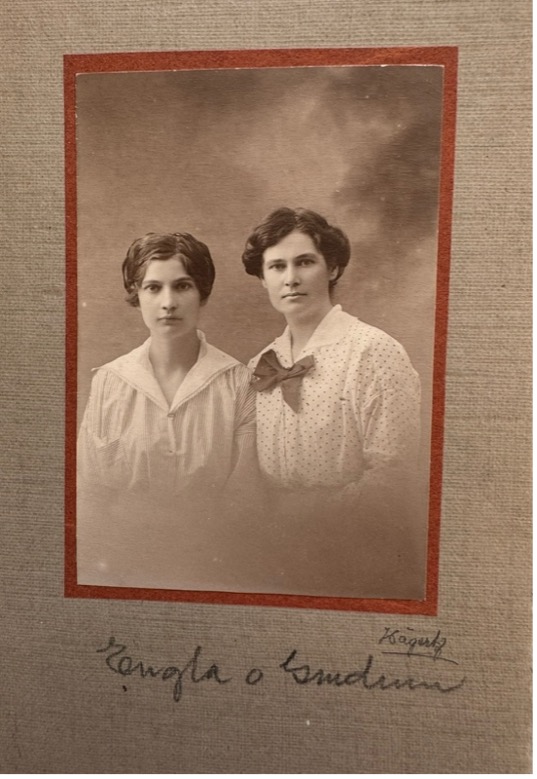
PS. I’ve enclosed a photograph of my sister Gudrun and myself—taken just outside our new studio on Bruksgatan. I thought it might make our letter feel a little less distant, a little more human. I hope you won’t find it presumptuous; it simply felt right to share an image, since that is the language I speak best.
We both admire your work greatly, even if we are just beginning to understand it. Perhaps one day, we will have the chance to meet—not just through letters or photographs, but in person, spirit to spirit.
Warmest regards once more,
Engla
Letter 2: July 1914
Hilma (51) → Engla (24)
From Munsö, Stockholm – to Bruksgatan, Oskarström
Dear Miss Hägertz,
Your letter reached me with the gentleness of someone attuned to more than just surface. Thank you for writing.
You ask how to stay true to a vision ahead of its time. I have asked myself the same. For years, I painted portraits, flowers, even scientific illustrations—works that others understood. But in 1906, something shifted. I began to receive messages. Not from the outer world, but from within. I was asked to paint the unseen.
Many do not understand what I do now. But I believe we are not alone in our creating. We are collaborators with something greater.
Keep seeing what others miss, Miss Hägertz. The world may catch up, but your vision must lead.
Warmly,
Hilma af Klint
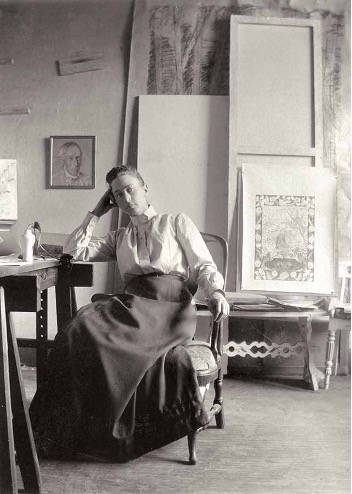
P.S. I’ve enclosed a small photograph of myself in my studio, alongside a preparatory sketch I made years ago. It later became part of a larger painting I titled Old Age, part of a series exploring the cycle of life—not as decline, but as transformation.
I share it not for judgment, but in the spirit of artistic kinship. Perhaps you will see in it something I did not intend—some echo or energy that speaks to you. I wonder: how do you read images that reach beyond clarity?
I would be most curious to hear your thoughts, not as a critic, but as a fellow seer of the in-between.
With kind regard once again,
Hilma
Letter 3: September 1915
Engla (26) → Hilma (53)
From Bruksgatan, Oskarström – To Ynglingagatan, Stockholm
Dear Hilma,
Thank you for your words. They offered strength in a year full of trial. My sister Gudrun and I are still learning the rhythms of running a studio—booking sittings, managing chemicals, chasing light. Yet more than that, I’m learning to listen.
You wrote that you were asked to paint the unseen. I feel I am learning to photograph it. A man came in with tired eyes and a soot-darkened face. When the image emerged, there was tenderness the world never saw in him. The lens, I believe, listens to light’s memory.
You said we are collaborators with something greater. Perhaps so. And perhaps that is the artist’s true commission.
With warmth and thanks,
Engla
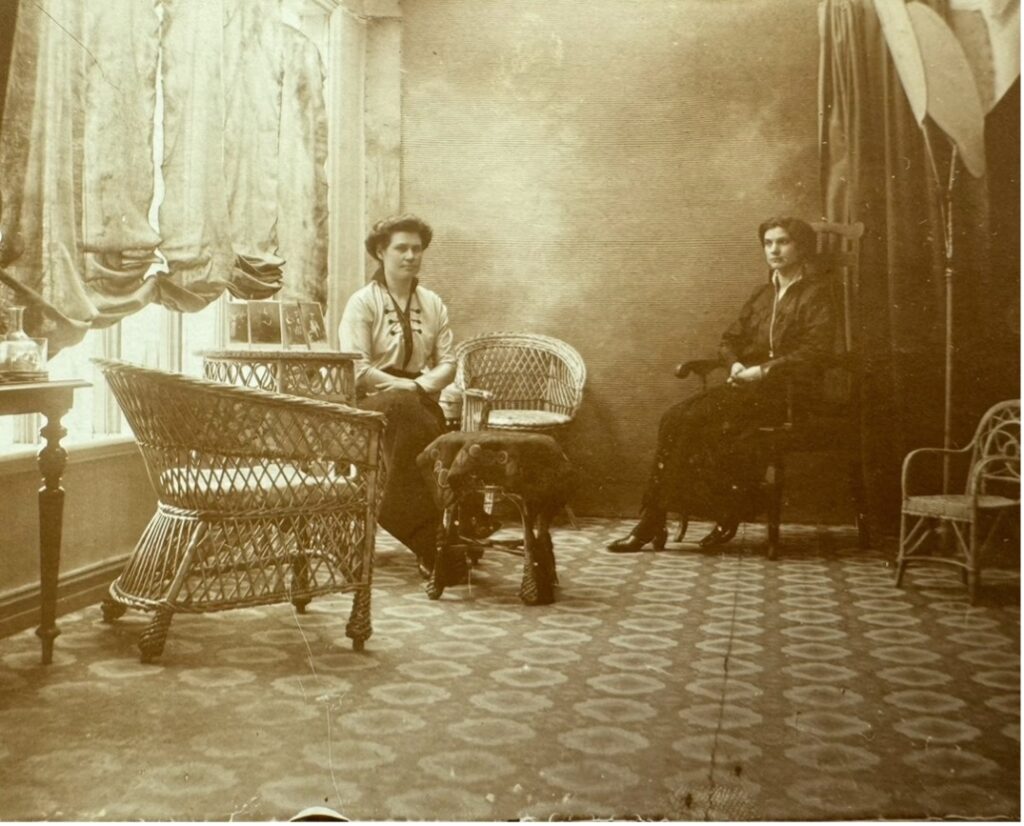
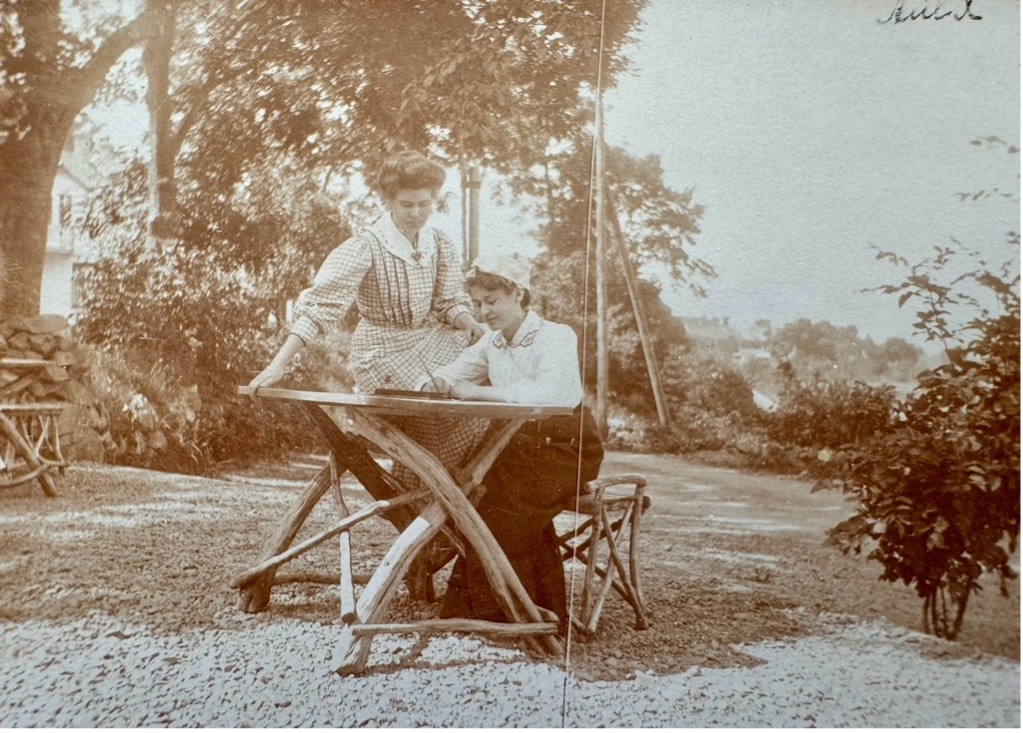
P.S. I’ve enclosed two photographs that I hope you’ll receive with interest. The first is from within our studio—a quiet moment between sittings, where light poured in just right across the backdrop and caught Gudrun adjusting the camera. I often find the in-between moments are the most revealing.
The second is from a recent visit to Arild, where we combined work and rest. The coastal landscape there felt more alive than any backdrop we could construct. The sea, the wind, the way the grasses lean—it all seemed to whisper something ancient. I felt more like a listener than a photographer.
I wonder—do you also find that nature speaks differently depending on where you are? And do you think the unseen you paint is sometimes nestled in the curve of a hill, or the hush of a tree?
Curious to hear what you see.
Warmly,
Engla
Letter 4: April 1917
Engla (27) → Hilma (54)
From Bruksgatan, Oskarström – To Ynglingagatan, Stockholm
Dear Hilma,
I write with a heavy heart. My sister Gudrun has passed. She fought bravely, but the illness overtook her this spring.
The studio feels hollow without her presence—her quiet hands, her strong laugh, her way of framing a shot before I even saw it. She was not only my sister but my co-creator. I wonder if you’ve ever felt a creative bond like that, one so woven into daily life that its absence feels like light missing from the room.
Still, I develop the prints we began together. I press flowers into books like we used to. I try to listen for her in the silence.
With grief and love,
Engla
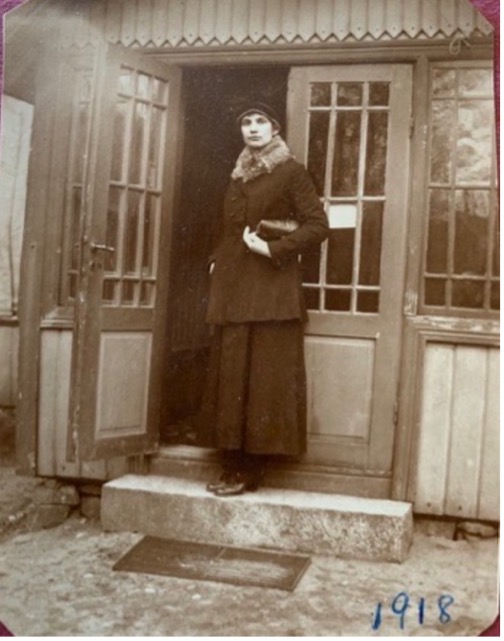
P.S. I’ve enclosed a photograph of myself standing on the doorstep of our studio. It was taken by a kind neighbor who sensed, I think, the pause in me. Some days I hesitate there—hand on the doorframe, heart holding its breath—half expecting to hear Gudrun’s voice from inside. For a moment, I still believe she might be there, adjusting the curtain, laughing at the sunlight catching the lens.
Do you know that feeling, Hilma? When absence doesn’t feel like an emptiness, but like a presence you cannot quite enter?
The studio remains filled with her touch, but I walk through it differently now. Quieter. Slower. More aware of everything we built together.
I share this image not as a portrait, but as a question. What do you see in it?
With a full and aching heart,
Engla
Letter 5: October 1917
Hilma (55) → Engla (28)
Från Ynglingagatan, Stockholm – Till Bruksgatan, Oskarström
Dearest Engla,
I am deeply sorry to hear about Gudrun. Such losses shape us, even as they try to undo us. In my own life, grief has often opened the doorway to deeper seeing.
I’ve just returned from Dornach, where Steiner’s vision is taking shape in the Goetheanum. I have also been exploring aand writing on Studies of the Life of the Soul. The building curves like thought itself. I believe architecture, painting, even photography can become temples of becoming.
In your portraits, you reveal the sacred in the ordinary. That is no small feat. That is alchemy.
Hold close what calls to you.
With care,
Hilma
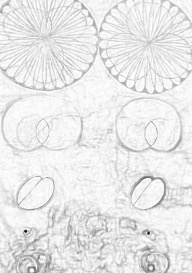
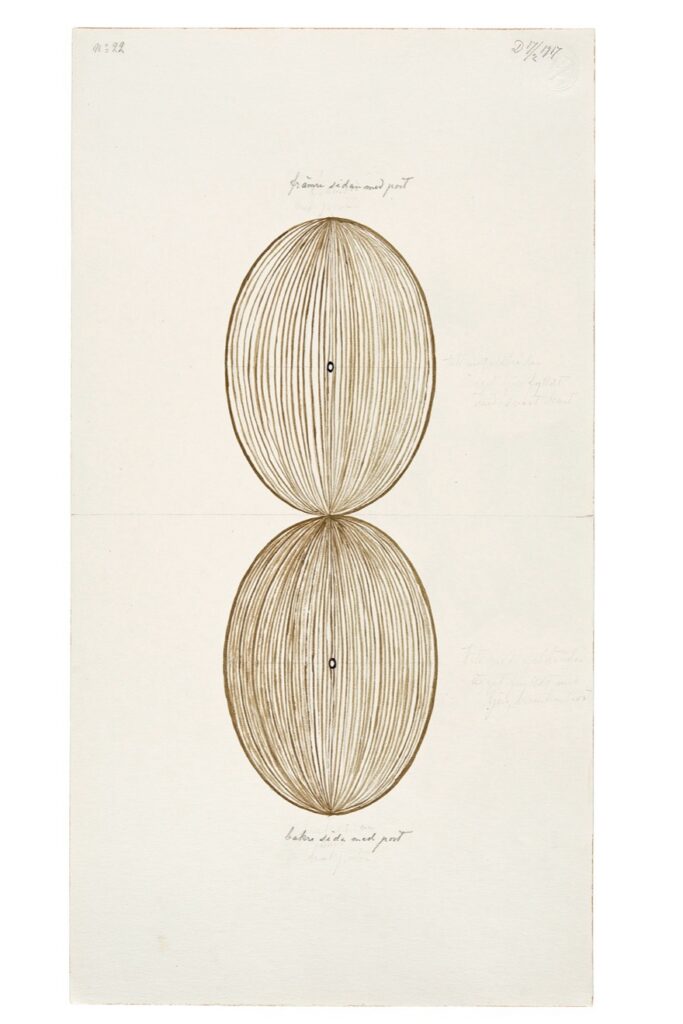
P.S. I’ve enclosed a small drawing—made during one of our recent séances. It came quickly, almost without thought, as if passed through me rather than from me. It is not a composition in the usual sense, but a trace—a symbol I do not yet fully understand.
I share it with you not as finished work, but as a gesture. A language of lines born in stillness. Perhaps it speaks more clearly to you than it does to me.
You mentioned listening for Gudrun in the silence. I wonder if what we call silence is sometimes where the truest presence lives. I do believe that in certain states—dream, grief, prayer, light through trees—we become more attuned to what moves beneath.
Let me know what you see, if you feel called.
With gentleness across distance,
Hilma
Letter 6: Spring 1919
Engla (30) → Hilma (56)
Från Bruksgatan, Oskarström – Till Munsö, Stockholm
Dear Hilma,
This spring has been both return and rebirth. I recovered from the fever that swept through last year and have resumed our studio. It feels different now—quieter, maybe deeper.
Your letters helped me through. The thought that my work, too, might be a temple—this stayed with me. I now photograph not only people but their gestures, their absences. What is not said has become just as present.
Thank you for showing me that form can hold silence.
With gratitude,
Engla
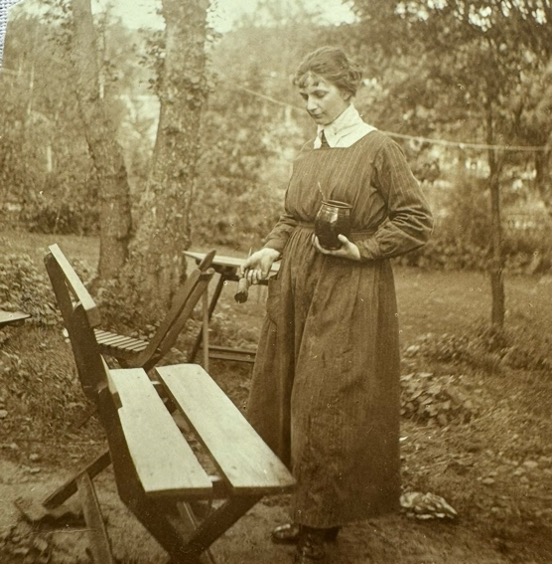
P.S. Lately, I’ve taken to bringing small bursts of color into my surroundings—painting the garden chairs sky blue, the table legs a hopeful green. It’s as if, after so much grey, I need the world to speak in brighter tones again. Even the simplest things—a tin watering can, a cushion on the step—have become little altars of intention.
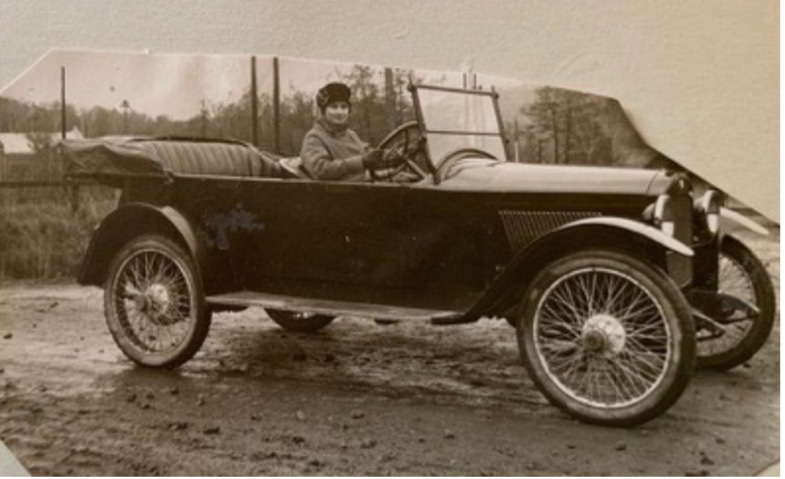
I’ve also done something I never imagined: I bought myself a car and have started learning to drive. There’s something freeing about being behind the wheel, wind in my hair, with no one expecting where I’ll go next. I’ve been visiting coastal towns with my camera, following nothing but light and feeling.
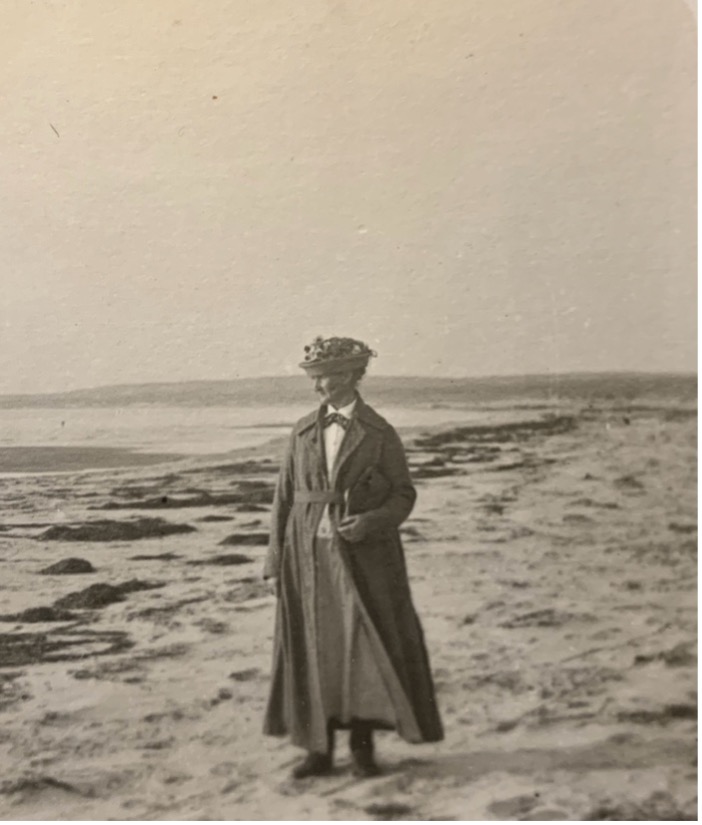
I’ve included a photograph of my mother, Josefina, standing on the beach at Tylösand. She looks out over the water with a kind of quiet courage. I often think of her resilience—and now I see I carry it, too.
I wonder—have you ever felt the need to color the world around you before returning to your canvas?
With spring’s unfolding,
Engla
Letter 7: Summer 1920
Hilma (58) → Engla (31)
Från Munsö, Stockholm till Bruksgatan, Oskarström
Dear Engla,
It delights me to hear you’ve taken to the roads in your own car! A woman with wheels is a marvel of our time. I, too, have wandered—to Mölle, to Dornach again. Travel shifts perception. So does illness. So does spirit.
I’m now painting trees—both real and imagined. I see you are photographing by the sea? The sea is another kind of spiral. May your images hold the rhythm of waves.
Yours in quiet motion,
Hilma
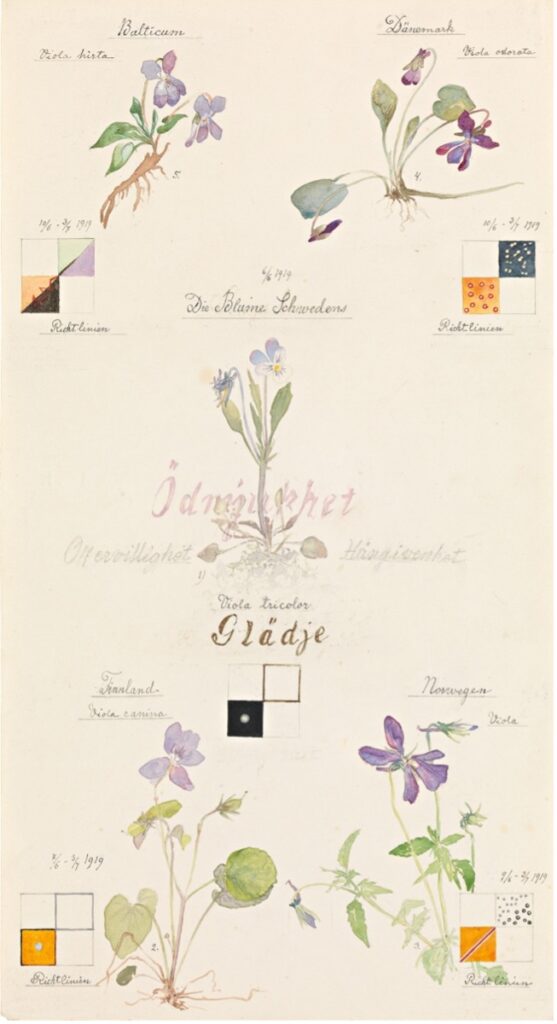
P.S. I’ve enclosed a page from my sketchbook—a study of blue violets I made while walking near Dornach. I’ve started calling it The Blue Swedes in my mind, perhaps because the colors reminded me of the way home feels in memory: tender, quiet, rooted.
The form came to me like a whisper—part flower, part symbol. I’m not certain what it means yet, but I feel it’s a link between body and spirit, soil and sky.
Do you ever name your photographs after feelings rather than places? Or after the people they remind you of?
I thought of you as I painted this. Perhaps it’s the rhythm of your seaside journeys that stirred the color in me. Let me know what you see in it—your eye often reveals what mine misses.
With traveling thoughts,
Hilma
Letter 8: August 1925
Engla (35) → Hilma (63)
From Bruksgatan, Oskarström – to Munsö, Stockholm
Dear Hilma,
I’ve been photographing reflections lately—people in mirrors, flowers caught in glass, faces in puddles. Something in your spiral paintings must have inspired this. They seem to say: the center is always elsewhere.
Sometimes I wonder, do we both use our crafts not to document but to translate? I think so.
With admiration,
Engla
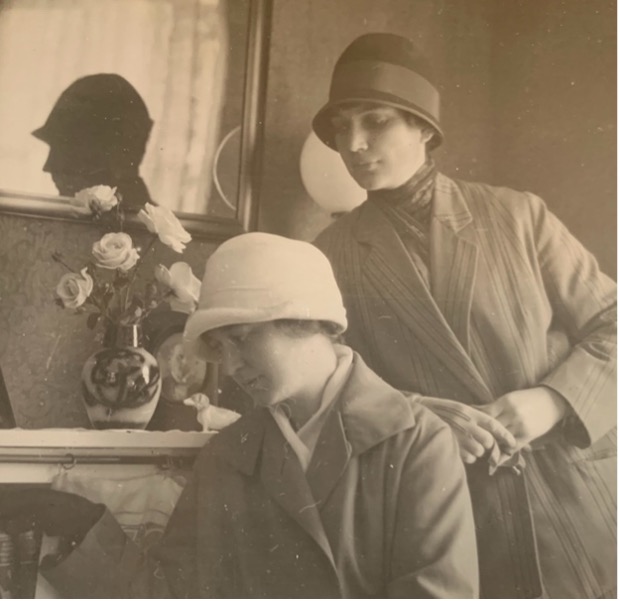
P.S. I’ve enclosed a photograph that feel like small riddle.
It showm my sister Hevig an dmyself. It shows me twice—once directly, and once in reflection. A mirror stood angled just so in the corner of our sitting room, catching more of me than I intended. Yet there’s something truthful in it. The seen and the seen-again. The self and the echo. I wonder if your spirals also carry that doubling—a movement toward something not yet fully revealed.
Do you ever find that your brush captures questions rather than answers?
With curiosity and affection,
Engla
Letter 9: January 1938
Hilma (76) → Engla (48)
From Grönegatan, Lund – to Bruksgatan, Oskarström
Dear Engla,
In Järna the trees are frozen but glowing. I’ve taken to sketching them again. Roots like prayers. I’ve also been dreaming of a round temple filled with paintings—not to display art, but to awaken something in the visitor.
You once asked if our work remembers. I say yes. It remembers what we forgot. What the world hurried past.
Yours in devotion,
Hilma
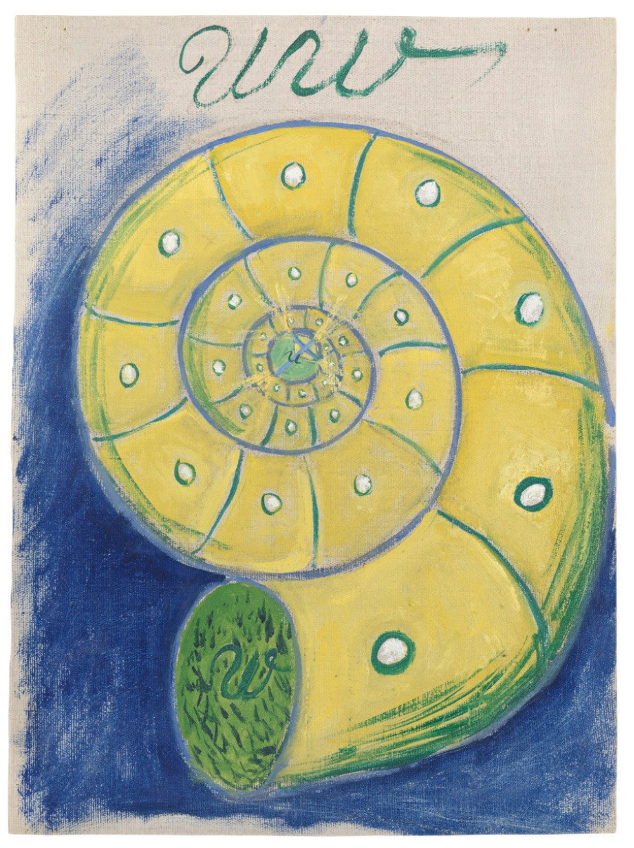
P.S. I’ve enclosed three small offerings that I hope will speak to you in different ways.
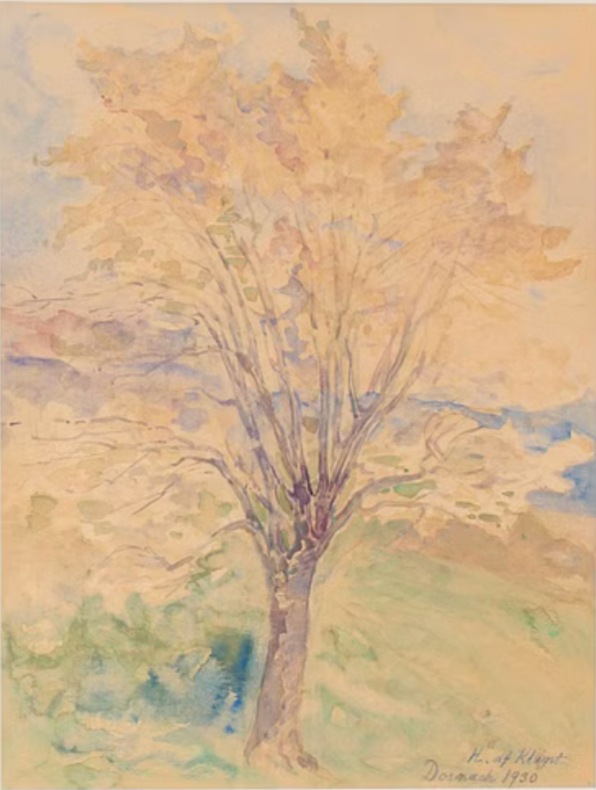
The first is a painting I made in Dornach in 1930—an earlier study of trees. Their branches reach upward like questions, while the roots, invisible at first, form a quiet geometry of trust beneath the surface. I was thinking of how growth is both ascent and descent—how spirit and soil speak to each other if we let them.
The second is a photograph of my place in Järna, taken on a frost-bright morning. The light was still and translucent, and I felt it carried something sacred—as if the house itself was listening.
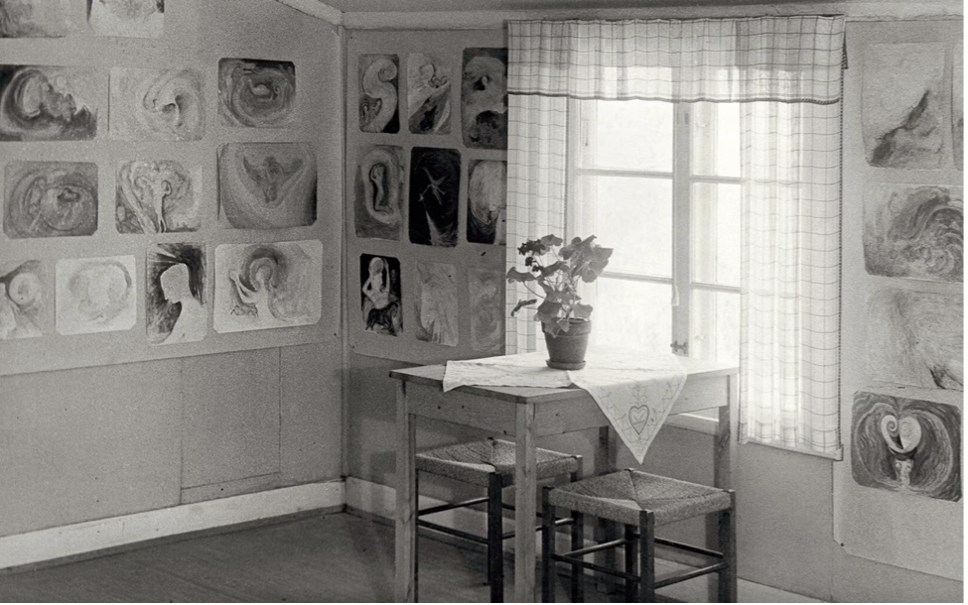
The third is a new sketch for what I now call The Temple Within. It is not a building as much as an intention—a place where images do not instruct, but resonate. The shape came to me in meditation: circular, unfolding, womb-like. Each wall would carry a cycle of paintings, each passage offering stillness.
Let me know what you feel in these fragments. You, with your gift for reading light, may see something I have only begun to sense.
With quiet hope,
Hilma
Letter 10: December 1939
Engla (49) → Hilma (77)
From Bruksgatan, Oskarström – to Hamngatan 5, Djursholm
Dear Hilma,
The world teeters again on the edge of war. I find myself returning to small things—hyacinths in the window, shadows on frost.
I think of you often. You tucked your work away, saying the world wasn’t ready. Was it trust or doubt that guided you? I hope it was trust. I try to trust too.
With quiet courage,
Engla
P.S. I’ve enclosed a few photographs that have become anchors for me in these uncertain days—fragments of light I’ve tried to hold onto.
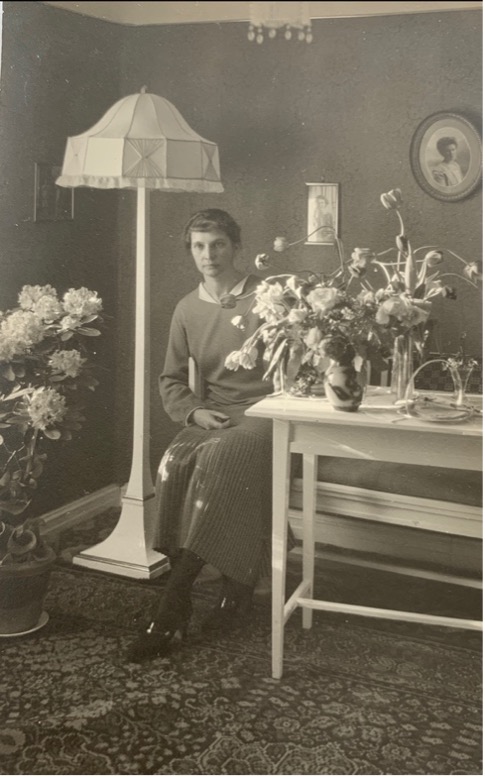
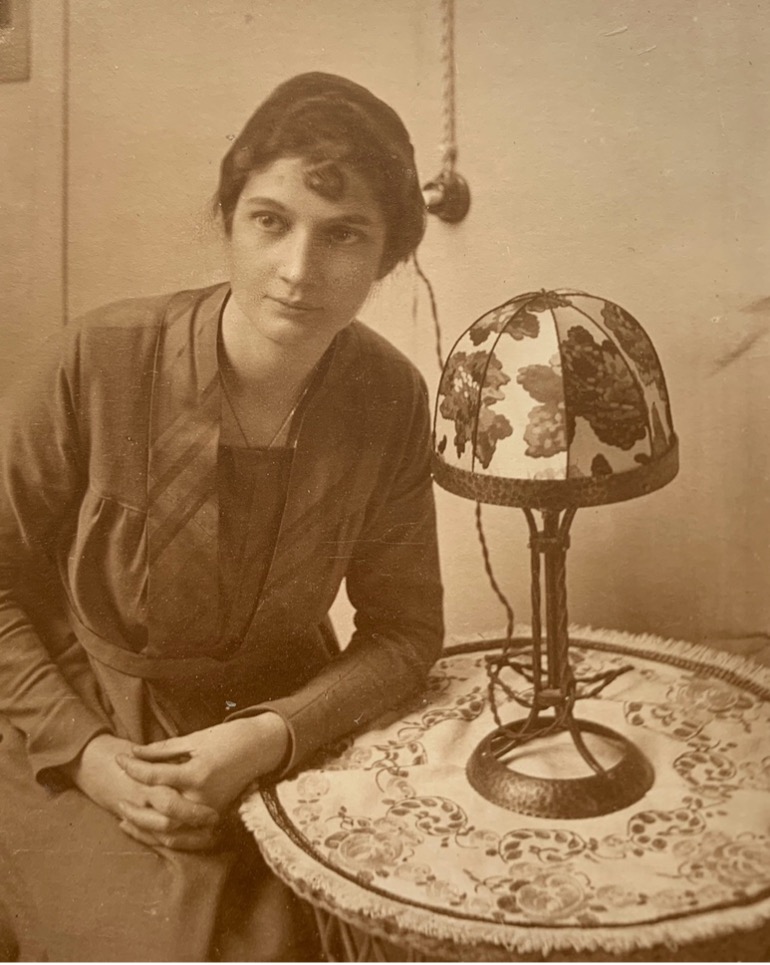
The first is a quiet portrait of myself with flowers on the table. Behind me on the wall hangs a photograph of my beloved Gudrun. It was taken years ago, but I find that her gaze still steadies me. Some days, it feels like we’re still working side by side.
Another shows me arranging flowers—some placed gently as a tablecloth embroidered by hand, others tucked on a lamp that casts golden light in the early evenings. These small gestures—flowers, linens, light—feel like ways of saying: We are still here. We still create beauty.
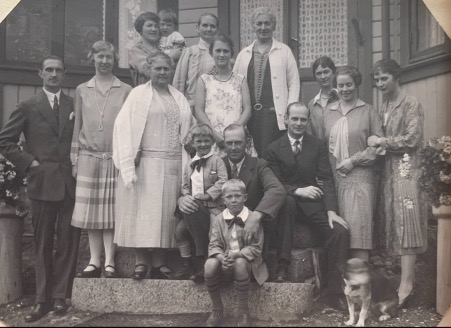
And finally, a larger photograph of my family: sisters, brothers, their husbands, wives, and children gathered in laughter and layered conversation. I look at it often now. In the face of what looms, it reminds me of what binds.
I share these with you not only as memory, but as testament—that even as the world edges toward shadow, we keep shaping light.
With tenderness across the distance,
Engla
Letter 11: September 1944
Hilma (82) → Engla (54)
From Hamngatan 5, Djursholm – To Bruksgatan, Oskarström
Beloved Engla,
I sense this is my final letter. My hands shake now, but the light is still within me. I have prepared the archive. Erik will guard it. Not yet understood, but not lost.
When you press the shutter, do you feel you are making something for a future eye? I always did.
You helped me feel less alone in this. Thank you.
In light,
Hilma
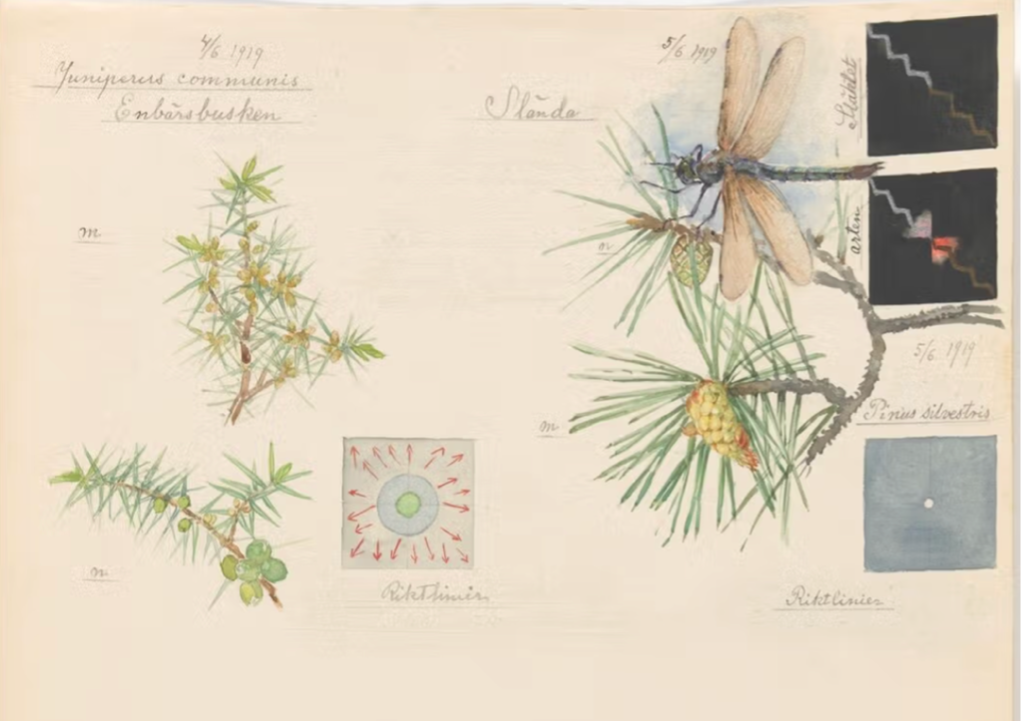
Ps. Adding my sketch of Pinus Silvestrus: Pinus sylvestris is a manifestation of the search for truth; it ascends to the heights and tells us: “try to reach the light, try to overcome what holds you back.” That obstacle is our disinterest in searching for the source of life; instead, we have an innate desire to create ourselves following our own rules. There is no possibility to create, for man draws from a common source the life skills that in part lie concealed, in part are revealed in the world of forms. In order to be able to come up with new forms we would have to understand what has already been created.
Afterword: A Dialogue Across Light and Time
The letters you have just read are fictional—but the lives, the art, and the questions they contain are very real.
Engla Hägertz, the quiet observer with a camera in her hands, left behind over 25,000 photographs. Her images of working families, children, flowers, and local life were never part of a major gallery show—but they became cherished reflections of a region and an era. She documented the beauty in the ordinary and made space for feeling in the formal.
Hilma af Klint, the painter who listened to inner voices, created more than a thousand visionary works—swirling with color, geometry, spirit, and symbolism. Her paintings, kept hidden for decades, are now recognized as foundational to abstract art. She imagined her works displayed in a temple not yet built—a future gallery of awakening.

Though these women never met, this exchange reimagines what might have occurred if their worlds had touched. Their imagined letters are a celebration of parallel courage:
– The courage to create without applause.
– The courage to trust invisible truths.
– The courage to leave behind a trace for others to follow.
In reading their words, we are reminded that some of the most important artistic conversations happen in quiet—between light and shadow, spirit and surface, brushstroke and shutter.
Their legacy is not only in what they created, but in what they make possible for us to see today.
Perhaps you, too, are listening to something others cannot yet hear.
If so—may these letters be your encouragement to continue.
Learn more
More about Engla Hägetz (google translated website) EnglaHagertz.se
Details about Engla from genealogy
More about Hilma af Klint (wikipedia) About Hilma af Klint
Hilma af Klint exhibition 2025 at Museum of Modern Art in New York
The newly authored book about an imaginary time of Hilma af Klints life, The invisible temple – a vision about Hilma af klint (in Swedish) by Ida There´n.
About Novisali

Novisali, (alias Liselotte Engstam), is besides her roles as professional board member and advisor, a multi-media artist, with a curious, explorative mind and an ambition to learn and extend art experiences to current and new audiences using both traditional and new digital mediums. More information and exhibitions can be found via Novisali.com
This blog post was is also shared at the blog of www.liselotteengstam.com, with the artist name Novisali.