Seeing More Slowly — On Photography, Time, and Image Analysis
(På Svenska Nedan)
I am currently attending a photography program, not primarily to learn how to take better photographs, but to rediscover how to see. Under the guidance of photographer Robert Wållberg, we are encouraged to approach photography more consciously — exploring composition, light, atmosphere, and the small decisions that transform an image from documentation into expression.
A central part of the work is image analysis. At first, this may sound technical, but it is in fact deeply reflective. To analyse an image is to pause and ask: What am I really seeing? Why does this image feel the way it does?
Image analysis becomes a way of slowing down perception. By reflecting on content, form, process, and mood, the inner structure of the photograph gradually reveals itself — how meaning is created through light, balance, color, and intention. Photography then becomes not only a way of capturing a moment, but a dialogue with the image itself.
The benefit is subtle but significant. You begin to understand not only what works, but why. Photography becomes less about technique and more about awareness — storytelling through attention.
Photography as a Way of Understanding
People who know me well know that photography has always been part of my life. I have always taken many photographs — not necessarily with the intention of creating art, but as a way of observing, remembering, and understanding. Perhaps photography has been one of my ways of learning about the world, about the people I meet, and about the events and moments I experience.
This fascination is also connected to my great-aunt Engla Hägertz, one of Sweden’s early photographers, who created tens of thousands of glass plates during her lifetime. I have long been fascinated not only by the historical periods she lived through, but also by her personal development as a photographer — how she observed people, documented lives, and how photography became both a technical and deeply human practice. Returning to photography now feels, in many ways, like continuing a conversation that began long before me.
When photography was first introduced in the nineteenth century, many artists expressed concern that art itself was now dead. If reality could be captured mechanically, what role would painting still have? History showed the opposite. Rather than ending art, photography liberated it. Painting moved toward impressionism, abstraction, and new forms of expression, while photography itself evolved into an artistic medium. Instead of replacing one another, both photography and art expanded. This moment in history reminds us that new technologies rarely end creative expression — they tend to widen it.
A Journey into Vintage Time
One of our assignments explored vintage photography — the attempt to recreate or interpret a historical aesthetic through contemporary images. By working with older objects, environments, and editing techniques, the task was not to imitate the past, but to understand how atmosphere is created. How light softens memory. How color fades into time. How composition shapes emotion.
For this exercise, I worked with three different setups, two of them connected to antique cameras from different eras.
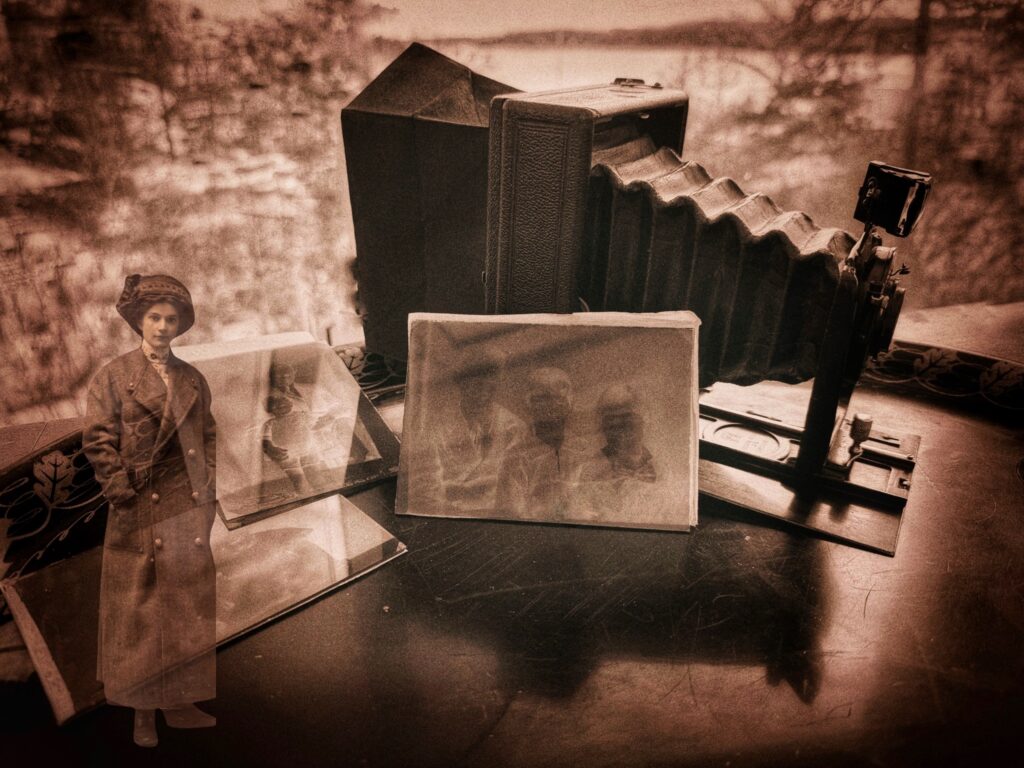
The first setup was built around an older large-format camera used for glass plate photography. The glass plates carry images of my grandfather, my father, and his siblings from the late 1920s. Through sepia tones, softened contrasts, and layered imagery, the photograph became less a document and more a carrier of memory. I placed my great-aunt Engla Hägertz — who herself took many of these photographs — into the composition in miniature form, allowing the photographer and the photographed to meet across time.
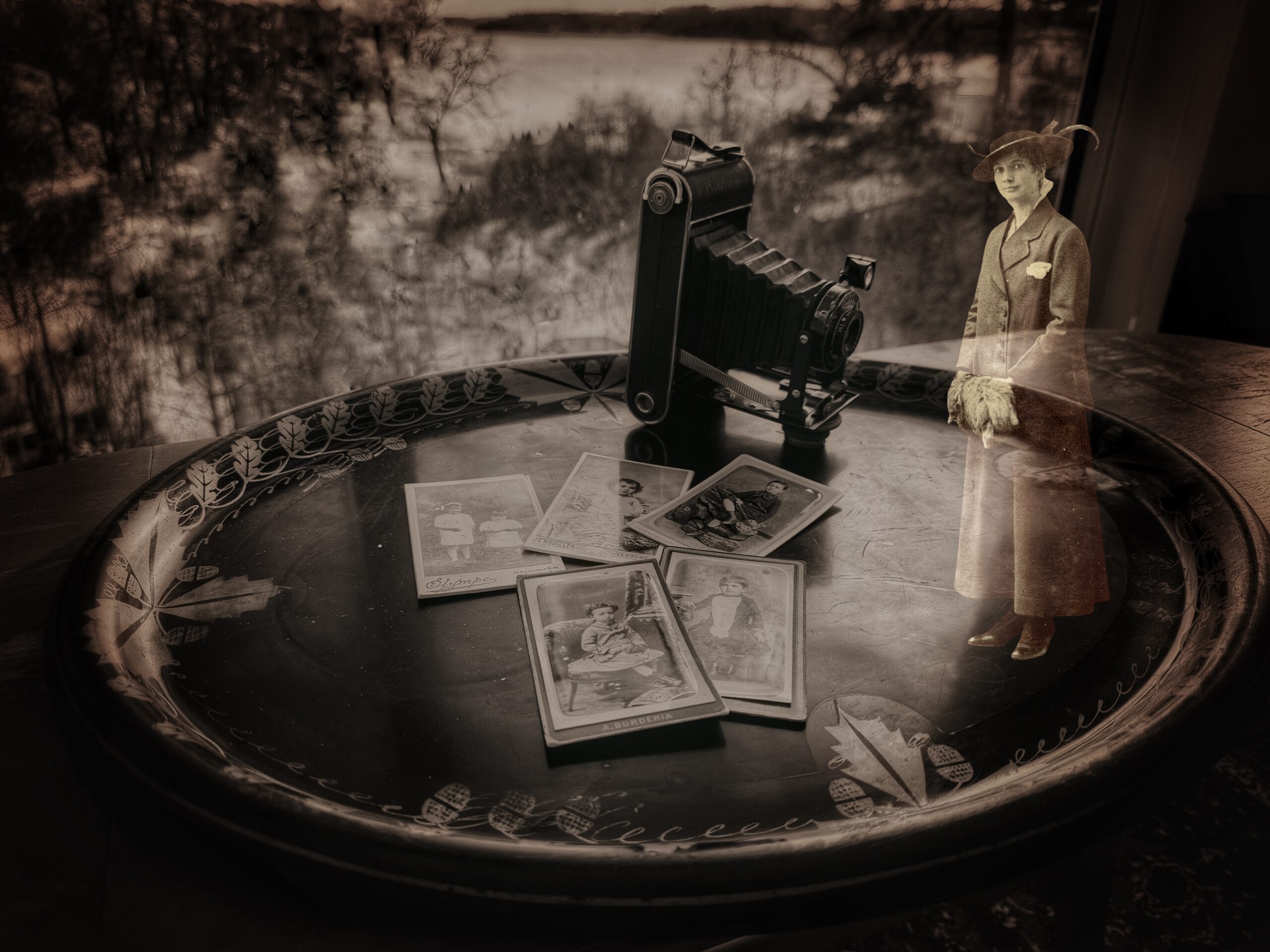
The second setup centered around a camera from the 1940s, surrounded by cabinet photographs that I recently purchased in Paris. Engla appears here as well, now at an older age. The circular composition and muted palette create a quiet continuity, where the camera becomes a bridge between past and present. The image revealed how form, content, and atmosphere must work together for a story to emerge.
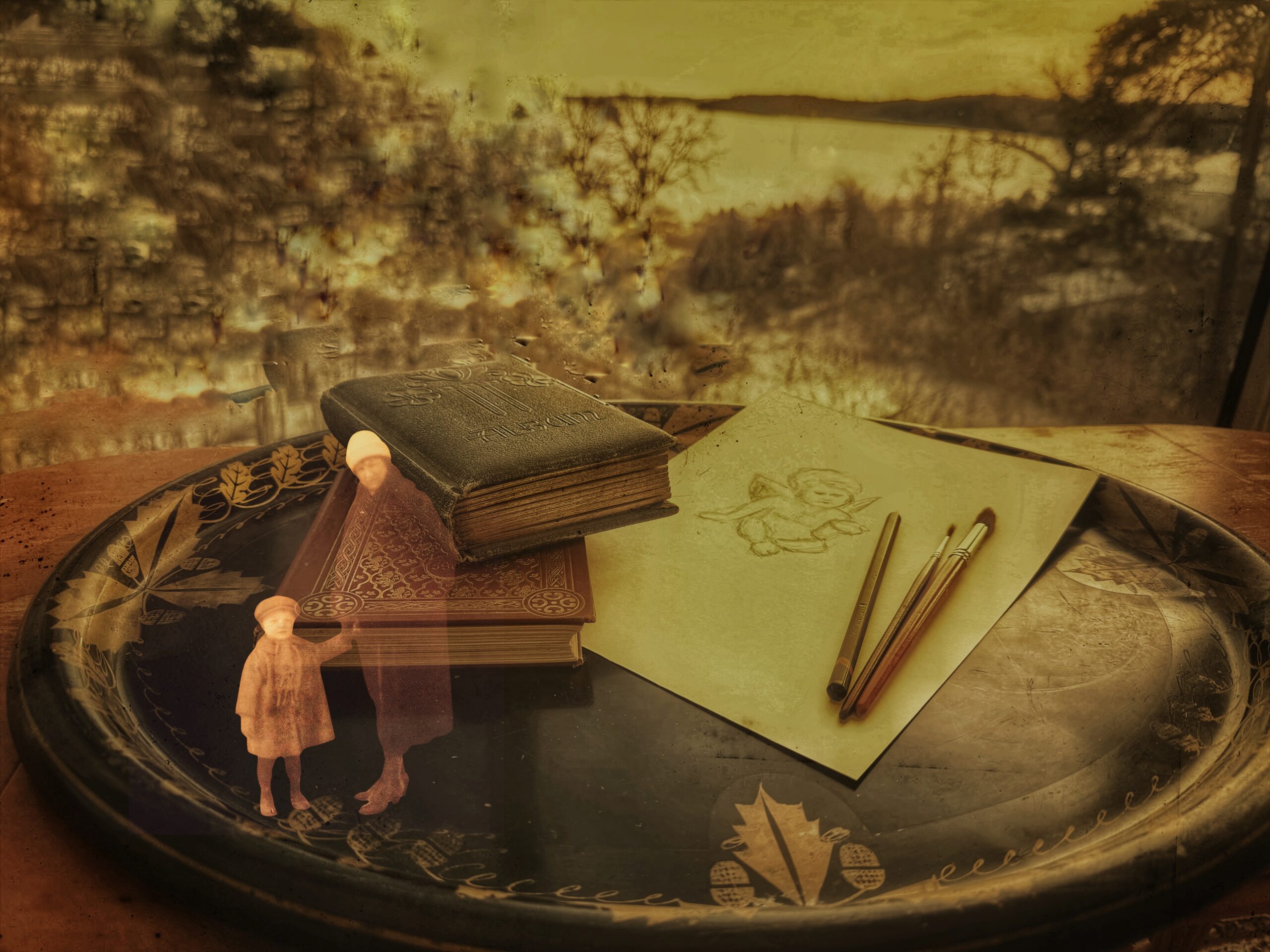
The third setup became more personal. Books, photo albums, a painted image of myself, and a small figure of my father as a child together with my grandmother formed a still life where memory and creation meet. Here, photography moved closer to reflection — less about history itself and more about how memory continues to shape us.
The Same Exploration Across Mediums
This process did not surprise me. I have long known that these approaches are closely connected to how I work as an artist. Rather, the photography exercise confirmed something I have experienced for a long time — that watercolor, photography, and digital transformation are different expressions of the same exploration.
In watercolor, I often begin with something observed and allow water and pigment to soften certainty. The image becomes less about describing reality and more about holding a moment in transition. When I later reimagine these works digitally or create living extensions through movement and light, I continue the same inquiry: how images can carry multiple layers of time, memory, and interpretation.
Working with photography allows me to return to my own artistic process with renewed awareness. The analytical perspective makes visible how atmosphere, balance, and emotion emerge — and how these qualities can move between mediums. In this sense, learning flows in both directions: from photography into art, and from art back into photography.
Photography and Art as Dialogue Across Time
Through these explorations, I return again to a recurring theme in my work as Novisali: the space between times. Photography, like watercolor and digital art, allows past and present to coexist. Technology, memory, and imagination meet within the same visual space.
Learning to see more slowly does not only change how images are made. It changes how we relate to what we see — and to what continues to emerge between the images themselves.
Perhaps the question is not only how we take a photograph, but what we begin to see when we allow ourselves to pause long enough.
References & Inspirations
This reflection draws on artists, writers, and thinkers who explore how images shape perception, how time lives within memory, and how art allows us to remain present within moments of transition. The following works have informed the thinking behind seeing more slowly — across photography, philosophy, and visual art.
Seeing — Attention and Perception
Robert Wållberg, Photographer – On Flickr
John Berger — Ways of Seeing
On how seeing precedes interpretation, and how meaning emerges through attention, context, and perspective.
Project Zero, Harvard Graduate School of Education — Artful Thinking Project
Research exploring slow looking and reflective observation as practices that deepen understanding and engagement with images.
Time — Duration and Presence
Henri Bergson — Stanford Encyclopedia of Philosophy
Bergson’s philosophy of duration describes time as lived continuity rather than measurable moments, resonating with photography’s layered sense of time.
Andrei Tarkovsky — Sculpting in Time
On art as a way of shaping and holding time, allowing past and present to coexist within a single image.
Memory — Photography and Meaning
Roland Barthes — Camera Lucida
A meditation on photography as the presence of what has been, where images carry memory, absence, and emotional resonance.
Marginalian on Susan Sontag — On Photography
Photography as interpretation rather than neutral documentation, shaped by framing and intention.
Related by Novisali
Echoes of Presence
Angles: The Silent Shifts of Perspective
Patterns and Forms: The Hidden Language Around Us
The Language of Shapes
When Nature Abstracts Itself
Close-Up: The Art of Seeing the Unseen
The Art of Balance — Details, Close-Up, and Symmetry
When Quiet Visionaries Speak
In the Silence Between Images
Att se långsammare — om fotografi, tid och bildanalys
Jag deltar just nu i en fotokurs, inte i första hand för att lära mig ta bättre fotografier, utan för att återupptäcka hur man ser. Under ledning av fotografen Robert Wållberg uppmuntras vi att närma oss fotografi mer medvetet — att utforska komposition, ljus, stämning och de små val som förvandlar en bild från dokumentation till uttryck.
En central del i arbetet är bildanalys. Det kan först låta tekniskt, men är i grunden något djupt reflekterande. Att analysera en bild är att stanna upp och fråga: Vad är det jag egentligen ser? Varför känns bilden som den gör?
Bildanalys blir ett sätt att sakta ner seendet. Genom att reflektera över innehåll, form, process och humör börjar fotografiets inre struktur framträda — hur mening skapas genom ljus, balans, färg och intention. Fotografiet blir då inte bara ett sätt att fånga ett ögonblick, utan en dialog med bilden själv.
Vinsten är subtil men betydelsefull. Man börjar förstå inte bara vad som fungerar, utan varför. Fotografi blir mindre teknik och mer medvetenhet. Ett berättande genom uppmärksamhet.
Fotografiet som ett sätt att förstå
De som känner mig vet att fotografi alltid har funnits med i mitt liv. Jag har alltid tagit många bilder — inte nödvändigtvis med ambitionen att skapa konst, utan som ett sätt att observera, minnas och förstå. Kanske har fotografiet varit ett av mina sätt att lära känna världen, människorna jag möter och de händelser jag upplever.
Denna fascination hänger också samman med min gammelfaster Engla Hägertz, en av Sveriges tidiga fotografer, som skapade tiotusentals glasplåtar under sin livstid. Jag har länge fascinerats inte bara av de historiska tider hon levde igenom, utan också av hennes egen utveckling som fotograf — hur hon betraktade människor, dokumenterade liv och hur fotografiet blev både en teknisk och djupt mänsklig praktik. Att återvända till fotografiet idag känns på många sätt som att fortsätta en pågående dialog.
När fotografiet introducerades under 1800-talet uttryckte många konstnärer en oro för att konsten nu var död. Om verkligheten kunde avbildas mekaniskt, vilken roll skulle måleriet då ha? Historien visade motsatsen. Istället för att avsluta konsten frigjorde fotografiet den. Måleriet rörde sig mot impressionism, abstraktion och nya uttrycksformer, samtidigt som fotografiet själv utvecklades till ett konstnärligt medium. Istället för att ersätta varandra expanderade både fotografi och konst. Denna historiska rörelse påminner oss om att nya tekniker sällan avslutar skapande — de vidgar det.
En resa in i vintage och tid
En av kursens uppgifter handlade om vintagefotografi — att återskapa eller tolka en historisk estetik genom samtida bilder. Genom att arbeta med äldre föremål, miljöer och redigeringstekniker handlade uppgiften inte om att imitera det förflutna, utan om att förstå hur stämning uppstår. Hur ljus mjukar upp minnet. Hur färg bleknar över tid. Hur komposition formar känsla.
I denna övning arbetade jag med tre olika uppsättningar, två av dem kopplade till antika kameror från olika tidsåldrar.
Den första uppsättningen utgick från en äldre storformatskamera för glasplåtsfotografi. Glasplåtarna bär bilder av min farfar, min pappa och hans syskon från slutet av 1920-talet. Genom sepiafärgade toner, mjuka kontraster och överlagrade bildlager blev fotografiet mindre ett dokument och mer en bärare av minne. Jag placerade in min gammelfaster Engla Hägertz — som själv tog många av bilderna — i miniatyrformat, så att fotografen och de fotograferade kunde mötas över tid.
Den andra uppsättningen kretsade kring en kamera från 1940-talet, omgiven av kabinettfotografier som jag nyligen köpt i Paris. Här framträder Engla igen, nu i högre ålder. Den cirkulära kompositionen och den dämpade färgskalan skapar en stillsam kontinuitet där kameran fungerar som en bro mellan dåtid och nutid. Bilden visade hur form, innehåll och stämning behöver samspela för att en berättelse ska uppstå.
Den tredje uppsättningen blev mer personlig. Böcker, fotoalbum, en målad bild av mig och en liten figur av min pappa som barn tillsammans med min farmor bildade ett stilleben där minne och skapande möts. Här närmade sig fotografiet reflektion — mindre om historien i sig och mer om hur minnet fortsätter att forma oss.
Samma utforskande i olika medier
Denna process överraskade mig inte. Jag vet sedan länge att dessa arbetssätt är nära förbundna med hur jag arbetar som konstnär. Snarare bekräftade fotografiövningen något jag länge upplevt — att akvarell, fotografi och digital transformation är olika uttryck för samma utforskande.
I akvarellen börjar jag ofta med något observerat och låter vatten och pigment mjuka upp det självklara. Bilden handlar mindre om att beskriva verkligheten och mer om att hålla ett ögonblick i förändring. När jag senare omtolkar verken digitalt eller skapar levande förlängningar genom rörelse och ljus fortsätter samma undersökning: hur bilder kan bära flera lager av tid, minne och tolkning.
Arbetet med fotografi gör att jag kan återvända till mitt eget konstnärliga arbete med ny medvetenhet. Analysen synliggör hur stämning, balans och känsla uppstår — och hur dessa kvaliteter kan röra sig mellan olika medier. Lärandet går därför i båda riktningar: från fotografi till konst, och från konsten tillbaka till fotografiet.
Fotografiet och Konst som dialog över tid
Genom dessa utforskanden återkommer jag till ett återkommande tema i mitt arbete som Novisali: mellanrummet mellan tider. Fotografi, liksom akvarell och digital konst, gör det möjligt för dåtid och nutid att samexistera. Teknik, minne och föreställning möts i samma bildrum.
Att lära sig se långsammare förändrar inte bara hur bilder skapas. Det förändrar hur vi förhåller oss till det vi ser — och till det som fortsätter att växa fram mellan bilderna.
Kanske är frågan inte bara hur vi tar en bild, utan vad vi egentligen börjar se när vi stannar upp tillräckligt länge?
References & Inspirations
Denna reflektion bygger på konstnärer, författare och tänkare som på olika sätt utforskar hur bilder formar vår perception, hur tid lever vidare i minnet och hur konsten gör det möjligt för oss att förbli närvarande i stunder av förändring. Följande verk har inspirerat tankarna bakom att se långsammare — i mötet mellan fotografi, filosofi och bildkonst. Se de faktiska referenserna i engelska delen.
Related by Novisali
Echoes of Presence
Angles: The Silent Shifts of Perspective
Patterns and Forms: The Hidden Language Around Us
The Language of Shapes
When Nature Abstracts Itself
Close-Up: The Art of Seeing the Unseen
The Art of Balance — Details, Close-Up, and Symmetry
When Quiet Visionaries Speak
In the Silence Between Images
About Novisali
Novisali, (alias Liselotte Engstam), is besides her roles as professional board member and advisor, a multi-media artist, with a curious, explorative mind and an ambition to learn and extend art experiences to current and new audiences using both traditional and new digital mediums. More information and exhibitions can be found via Novisali.com
This blog post is also shared at the blog of www.liselotteengstam.com, with the artist name Novisali.